
Today, toy manufacturers face strict safety rules. Thanks to regulations like the ASTM F963: Standard Consumer Safety Specification for Toy Safety, U.S. toymakers must adhere to many guidelines. This ensures our children play with toys designed with safety as a top priority.
However, this wasn’t always the standard. Before governments actively protected kids from hazards like lead-painted figurines, earlier generations were often given some genuinely wild toys and sent off to play. This list explores ten toys that demonstrate just how much tougher our grandparents’ generation had to be.
10. Belt Buckle Derringer Toy Gun

In 1959, Mattel introduced a toy gun that didn’t require hands for operation. The Belt Buckle Derringer Toy Gun could be fired conventionally. But, if a child found their hands tied up, they could still fire it! This gun attached to a belt buckle and discharged when the wearer thrust their hips forward.
Imagine young boys running around with toy cap guns strapped to their waists, firing plastic bullets with a hip wiggle. As one might guess, these guns sometimes fired unexpectedly and in unintended directions. Even when fired intentionally, they must have caused quite a bit of chaos.
9. Gilbert Glass Blowing Set
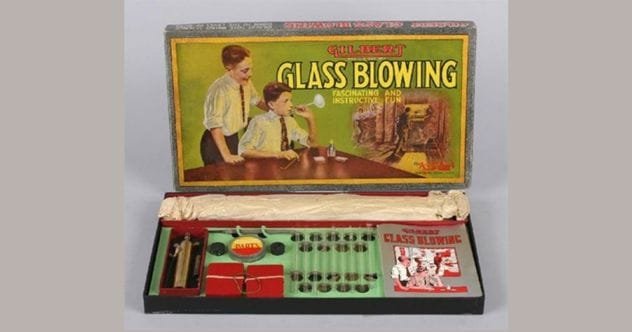
“I wish my child had a kit to shape molten glass” isn’t a common thought for parents today. Yet, a real glass-blowing set for children once existed. The A.C. Gilbert Company, now defunct, was known for erector sets, trains, and chemistry kits—typical children’s items.
However, in the 1920s, A.C. Gilbert offered something quite different: a functional glass-blowing set. Marketed as the Experimental Glass Blowing Kit for Boys, it included a blow torch for heating glass until soft, tubes for blowing and shaping it, and an instruction book. This book suggested “fun” experiments where children were told to hold the heated glass. For glass to be workable, it needs to reach at least 1500°F (815°C).
8. Austin Magic Pistol

Toy guns were very popular in the past, but the Austin Magic Pistol was unique, looking like something from a sci-fi movie. This 1940s toy had a futuristic design and launched ping pong balls. Sounds harmless, doesn’t it? Not when you learn the ping pong ball was propelled by an explosive chemical reaction using calcium carbide and water.
Users mixed water with the provided “magic crystals,” loaded the gun, and were ready to fire. These “magic crystals” were actually calcium carbide, a hazardous material that becomes a highly flammable gas upon contact with water. Each shot from the Austin Magic Pistol caused an explosion in the gun’s chamber. It’s a wonder how our grandparents survived toys that launched projectiles via chemical explosions.
7. Creepy Crawlers

Though potentially dangerous, this toy must have been incredibly fun for kids. In 1964, Mattel launched the Thingmaker. It became so popular that 15 different sets were released. The set that seems to evoke the most nostalgia online is Creepy Crawlers.
The Thingmaker featured an oven with an internal heating element that reached 400°F (204°C). The “things” were created by squirting a chemical fluid Mattel called Plasti-Goop into die-cast metal molds and then heating them. By 1973, however, toy safety regulations had tightened. The Thingmaker, with its high temperatures and chemical fumes, vanished from store shelves. Mattel recently explored a 3D printer version to revive this beloved toy, but unfortunately, it never reached the market.
6. Sixfinger

This toy was aimed at kids who wanted asixth finger capable of writing and firing various objects like bombs, missiles, and messages. Created by Topper Toys, its design wasn’t the most appealing, but children could wear it for fun—because what’s not fun about an extra finger? The TV commercial even questioned how we managed with only five!
Designed in the 1960s by Deluxe Reading, a toy manufacturer in Elizabeth, NJ, which produced toys under several brand names including Topper Toys. Individually, the functions of the Sixfinger weren’t extraordinary—anyone can use a pen or play with a toy gun. But combining these with a strange-looking extra digit held between the thumb and forefinger made it a hit.
5. Zero-M Sonic Blaster

Mattel strikes again! Mattel’s sonic blaster bazooka gun was essential for every aspiring secret agent. It was a 34-inch-long (86-centimeter) blaster that shot hand-pumped compressed air at such high decibels it could cause lifelong hearing damage.
You can still find the vintage ad on YouTube, featuring a young Kurt Russell. He navigates a black and white world, firing his weapon at leaf piles and wind chimes to survive. One might wonder what stopped children from stuffing things like dirt and rocks into the blaster and launching them. The answer is: nothing. That’s precisely the kind of thing children would do. This, along with the hearing damage risk, is why you can’t find anything like the Zero-M Sonic Blaster for today’s more protected children.
4. Clackers

Like many toys from the ‘60s and ‘70s, Clackers were simple. Two balls were attached to a string, which a child could smack together to make a loud, satisfying (at least to the child) sound. Banging two balls together doesn’t sound too bad initially. However, the original clacker balls were made of glass.
What happens when a small child violently bangs glass balls together? Predictably, the glass often shattered, sending dangerous shards flying. The Food and Drug Administration banned these toys in 1971. This led Sarah Slobin from Quartz to suggest that the outcry over clackers might have contributed to “sowing the seeds for the helicopter parenting style of today.”
3. Zulu Blow Gun
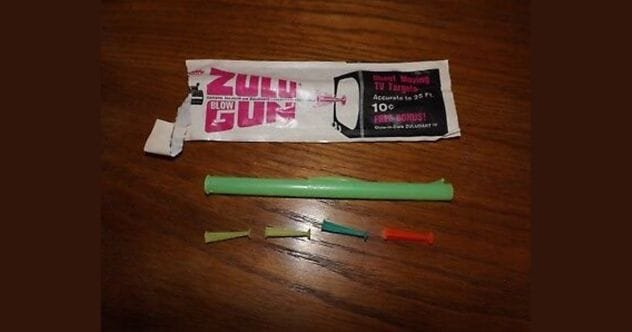
In the 1950s, the Zulu Blow Gun was a favorite, allowing children to blow foam pellets at each other. The issue arose when a child inhaled deeply to muster the air to launch the pellet. Sometimes, they would inhale with the gun to their mouth, accidentally sucking the pellet down their throat instead of firing it.
Blow dart toys are still sold today, but modern versions protect children from inhaling foam pellets by using one-way mouthpieces. This simple safety feature makes a big difference.
2. Baby Cages

It takes a tough individual to have spent their toddler years suspended outside a 10-story high-rise window in a metal wire cage. Baby cages were primarily used from the 1920s to the 1950s. Their purpose was to allow parents in small city apartments to provide their children with fresh air and sunshine.
The interest in baby cages, invented by Emma Read in 1922, likely stemmed from the 1884 book The Care and Feeding of Children. A section titled “Airing” recommended regular fresh air for children.Remarkably, there seem to be no recorded accidents or deaths from baby cages, but you certainly won’t see any babies suspended from high-rise apartments today.
1. Empire Little Lady Stove

While many items on this list fall into the category of traditional “boy’s toys,” don’t assume that conventional “girl’s toys” were any safer. The glass-blowing kit might have been labeled “for boys,” but the Empire Little Lady Stove featured exposed burners and could reach temperatures up to 600°F (315°C). This proves that girls of that era were just as resilient.
The Empire Little Lady Stove was one of the first casualties of federal toy safety standards. In 1969, the National Commission on Product Safety banned the toy due to its hazardous design.
Looking back at these toys, it’s clear that childhood play involved a different level of risk. While we prioritize safety today, these items offer a glimpse into the resilience of past generations. What do you think about these vintage toys?
Leave your comment below and share your thoughts!