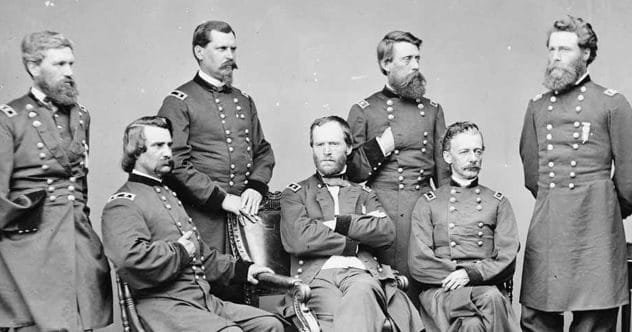
Many know names like Robert E. Lee or Ulysses S. Grant from the Civil War. But what if I told you a Cherokee chief, a best-selling author, and even a U.S. President were also generals in this historic conflict? The American Civil War, the deadliest in U.S. history, brought together a fascinating array of individuals whose fame often extended far beyond their military service. Let’s dive into the unexpected lives of ten such figures.
10. Lewis Wallace

Lewis “Lew” Wallace had a mixed military career, serving in both the Mexican-American and Civil Wars. As a general under Ulysses S. Grant, he faced criticism for allegedly being late with reinforcements at the Battle of Shiloh in 1862, a claim he always denied. However, Wallace later played a key role in stopping Confederate General Jubal Early’s advance on Washington, D.C., at the Battle of Monocacy.
Beyond the war, Wallace’s life was full. In 1878, he became the territorial governor of New Mexico. During his time there, he worked to end the Lincoln County War and even met with Billy the Kid to offer amnesty. Later, he served as an ambassador to the Ottoman Empire from 1881 to 1885. Yet, his most enduring fame came from his writing. His 1880 novel, Ben-Hur: A Tale of the Christ, was a massive success, leading to famous film adaptations in 1959 and 2016.
9. Lawrence Sullivan Ross

Lawrence Sullivan Ross, or “Sul,” moved with his family to Texas in 1839, where they helped establish the town of Waco. In 1860, he joined the Texas Rangers and was involved in the recovery of Cynthia Ann Parker, who had been kidnapped by Comanche Natives as a child. When Texas seceded, Ross became a Confederate general, serving with note in the war’s western theater.
After the war, Ross managed his farm and ranch. He was sheriff of Waco from 1873 to 1875, arresting nearly 700 outlaws. He then entered politics, becoming a state senator and later the governor of Texas. As governor, he focused on land-use and tax reforms and expanded state charity efforts. In 1891, Ross became president of the struggling Texas Agricultural and Mechanical College (now Texas A&M University). He greatly improved the campus and fostered a strong school spirit that continues today.
8. Jefferson Columbus Davis

Jefferson Columbus Davis, a Union general, often caused confusion due to his name being similar to that of the Confederate President, Jefferson Finis Davis. He served effectively in the Mexican-American War and was at Fort Sumter when it was bombarded, marking the start of the Civil War. He commanded troops in the western theater before an assignment in Louisville, Kentucky, under General William “Bull” Nelson.
Davis and Nelson disliked each other instantly, leading to Nelson relieving Davis of command. When Davis was reassigned to Louisville, a confrontation escalated. Insults were exchanged, leading to a physical altercation. Davis then retrieved a pistol and shot General Nelson, who died shortly after. Though arrested, Davis was quickly released due to the army’s need for officers. He served for the rest of the war without facing legal consequences for the shooting, but the incident made him infamous.
7. Benjamin McCulloch

Born in Tennessee in 1811, Benjamin McCulloch was a friend of the famous frontiersman Davy Crockett. Crockett convinced McCulloch to join the Texas Revolution in 1836. He fought in the decisive Battle of San Jacinto and later served as an Indian fighter with the Texas Rangers. McCulloch also defended South Texas from Mexican raids and fought in the Mexican-American War under future U.S. President Zachary Taylor.
Between the Mexican War and the Civil War, McCulloch became a “49er” prospecting for gold in California. He also helped negotiate peace with Brigham Young in Utah. After Texas seceded in 1861, McCulloch was appointed a brigadier general. He raised a large army in Texas that fought successfully in the western theater until his death at the Battle of Pea Ridge in Arkansas.
6. James A. Garfield

James A. Garfield rose from humble beginnings in Ohio to become the 20th President of the United States. Before his presidency, he was an educated man, a noted abolitionist, and a Union general during the Civil War. He served primarily in Tennessee until 1863 when he was elected as a U.S. representative for Ohio.
As a Radical Republican, Garfield supported Reconstruction and was influential in financial matters, backing anti-inflation policies and the gold standard. Garfield also had a keen interest in mathematics. In 1876, he published a well-regarded proof of the Pythagorean theorem. He won the 1880 presidential election, defeating fellow Union general Winfield Scott Hancock. As president, he pushed for reforms, including civil rights for formerly enslaved people. Tragically, in 1881, Charles Guiteau, who had been denied a political office, shot President Garfield. He died from an infection after serving only about 200 days in office.
5. John C. Breckinridge

John C. Breckinridge hailed from a prominent Kentucky family; his grandfather was Thomas Jefferson’s attorney general. An affluent politician before the Civil War, he studied law at Princeton and graduated from Transylvania University. He was elected to the Kentucky state legislature in 1849. As a states’ rights Democrat, he was soon elected to the U.S. House of Representatives.
In 1856, Breckinridge became James Buchanan’s running mate, and their victory made him the youngest vice president ever, at age 36. When Abraham Lincoln ran for president in 1860, the Democratic party split. Southern states nominated Breckinridge, while Northerners favored Stephen Douglas. Lincoln won, and Breckinridge accepted a Senate seat. However, his sympathies lay with the Confederacy, so he resigned and became a Confederate general. He struggled as a military leader, not having a professional military background, and had a bitter rivalry with General Braxton Bragg. He survived the war but died in 1875 from cirrhosis.
4. George B. McClellan

George Brinton McClellan, like Breckinridge, also ran for president against Abraham Lincoln, though his campaign was in 1864. McClellan was a career military man who served with distinction in the Mexican-American War and observed the Crimean War. After the Union Army’s poor performance at the First Battle of Manassas in 1861, Winfield Scott resigned as General-in-Chief, and Lincoln appointed McClellan to the role.
McClellan excelled at training and organizing, greatly improving the Union Army. However, his battlefield performance was often criticized. Known for being overly cautious, he was blamed for failing to defeat Confederate forces and was replaced by Henry W. Halleck after the Seven Days Battles in 1862. In the 1864 presidential election, McClellan ran on a platform of negotiating an end to the war with the Confederacy but lost significantly. After the war, he was elected governor of New Jersey and spent his later years defending his wartime record.
3. Stand Watie

Stand Watie holds two unique distinctions: he was the last Confederate general to surrender and the only general on either side with Native American ancestry. Born Degadoga (“He Stands”) on Cherokee land in Georgia, he was active in tribal politics. He was one of four chiefs who signed the Treaty of New Echota, which exchanged traditional Cherokee lands for new territory in what is now Oklahoma. This led to the tragic “Trail of Tears” and a lasting feud with factions led by Chief John Ross, who had the other treaty signers executed; Watie escaped.
When the Civil War began, Watie joined the Confederate Army and rose to the rank of brigadier general. He fought mostly in Arkansas, Louisiana, and the Indian Territory. Watie was the final Confederate general to surrender to Union forces in June 1865. Later, he was a delegate in renegotiating treaties with the United States. The character Lone Watie in Clint Eastwood’s 1976 film The Outlaw Josey Wales is loosely based on Stand Watie.
2. George Crook

George Crook became a renowned general of the Old West after his Civil War service. He graduated from West Point in 1852 and fought in the Civil War, notably under Philip Sheridan during the Valley Campaign of 1864. His true fame, however, came after the war when he was sent west to deal with conflicts involving several Native American tribes. He led campaigns against the Sioux in the mid-1870s, which included his defeat at the Battle of the Rosebud in 1876; this outcome might have influenced George Custer’s fate at Little Bighorn.
In 1881, Crook returned to Arizona to fight the Apache tribe, largely led by the famed warrior Geronimo. The Apache nicknamed Crook the “Tan Wolf,” respecting him as a strong but fair enemy. During one pursuit, Crook, while hunting alone, encountered Geronimo and his warriors. They did not attack but instead discussed peace terms, which Crook negotiated fairly. When Geronimo later violated these terms, Crook had to bring him in again but soon lost his post. He spent his final years advocating for the U.S. government to honor its treaties with Native Americans. His former enemy, Chief Red Cloud, said of him, “He never lied to us. His words gave my people hope.”
1. Leonidas Polk

Leonidas Polk’s career started and ended in the military. He graduated from West Point in 1827 and died from a cannonball during the Atlanta Campaign in 1864 as a Confederate general. However, the time in between was spent not in uniform but as an Episcopal priest and later a bishop.
In 1838, he was appointed Missionary Bishop of the Southwest and became Bishop of Louisiana in 1841. His life’s work led to the founding of the University of the South in Sewanee, Tennessee, in 1860, which still exists today. When the South seceded in 1861, his old friend Confederate President Jefferson Davis convinced Polk to accept a generalship. As a general, his men liked him, but his superior, General Braxton Bragg, doubted his military skills. Polk was killed by cannon fire in 1864, just four years before his university officially opened.
These ten generals show that historical figures are often more complex than their most famous roles suggest. Their lives beyond the battlefield—as writers, politicians, educators, and leaders in other fields—add fascinating layers to the story of the Civil War era.
What other Civil War figures had surprising careers outside the military? Share your thoughts in the comments below!