The United States is often called a melting pot, a place where cultures from around the globe blend together. This is especially true when it comes to food! Immigrants brought their cherished recipes and culinary traditions, enriching America’s palate. We love our pizza, tacos, and chow mein. But here’s a twist: what if some of the ‘foreign’ dishes we adore weren’t actually imported? Get ready to be surprised as we uncover ten popular foods you thought were from abroad but were actually born right here in the USA!
10 Frozen Garlic Bread (Michigan)

Walk into almost any Italian restaurant, and you’ll likely spot garlic bread on the menu. But here’s a surprise: while Italian immigrants inspired it, this popular side dish is thoroughly American, especially the frozen version you buy at the store! Its creation is a classic tale of American resourcefulness.
In the early 20th century, many Italians came to the U.S., bringing their food customs. They settled in cities like New York and Philadelphia, where Mediterranean ingredients such as olive oil were hard to find or expensive. Transporting olive oil from Italy or even California was costly. However, butter was plentiful and affordable.
Italians had long enjoyed bruschetta, which traditionally uses olive oil. Italian Americans adapted by using butter instead. They added garlic for extra flavor, and a delicious new habit began within their families. For decades, this buttery, garlicky bread was a homemade favorite.
This changed in 1973 when Cole’s Bakery in Muskegon, Michigan, started mass-producing garlic bread. They froze the loaves and distributed them nationwide. Americans loved it instantly. Today, Cole’s continues to thrive, and garlic bread is a popular item across the U.S. – very much an American creation with an Italian touch! [1]
9 Spaghetti And Meatballs (New York)

If learning about garlic bread’s American roots surprised you, get ready for this one. Spaghetti and meatballs surely must be straight from Italy, right? Not quite! Like garlic bread, this beloved “Italian” dish was actually created in America, born out of necessity and opportunity.
Traditional Italian cuisine definitely includes pasta. There’s also a meat dish in Italy called “polpette,” which are small meat morsels. However, these are typically made from various meats like goat, fish, beef, or chicken, and they are never served with pasta. Combining pasta and meatballs didn’t happen until Italians immigrated to America. Once here, these two ingredients were united with a crucial third element: marinara sauce.
In Italy, difficult economic conditions and World War I meant that many people had limited access to meat. But in America, meat was abundant and affordable! Even lower-quality meats were very cheap. Italian immigrants cleverly minced these meats and mixed them with breadcrumbs to make delicious meatballs. Canned tomatoes and tomato sauces were also readily available in the new country. Soon, Italian-American home cooks began serving generous portions of pasta topped with marinara sauce and hearty meatballs. This combination created a perfect, satisfying meal – a truly American dish blending old-country ingredients with new-world creativity. Mamma mia, indeed! [2]
8 Chimichangas (Arizona)

Legend has it that the chimichanga was born from a happy accident. One day in 1922, Monica Flin, working at El Charro Restaurant in Tucson, Arizona, accidentally dropped a burrito into a deep fryer. Annoyed at her mistake, she started to utter a Spanish curse word, “chingada!” but quickly changed it to the nonsensical “chimichanga!” When she pulled the burrito from the hot oil, she noticed it didn’t look half bad.
Curiosity piqued, she let the fried burrito cool and then took a bite. It was delicious! And just like that, a new Mexican-American culinary star was born. El Charro is still a thriving, family-owned restaurant in Tucson today, proudly claiming Flin’s invention.
However, that’s not the only story. While the chimichanga is definitely not an import from Mexico, there’s a debate about its exact Arizona birthplace. Macayo’s Mexican Restaurant, located in Phoenix, also claims to be the originator. According to their story, owner Woody Johnson began deep-frying unsold burritos in the 1940s, supposedly calling them “toasted monkeys.” Since “changa” is Spanish for “monkey,” Macayo’s supporters believe this is how the name came about.
With two compelling origin stories, the true inventor might never be definitively known. It’s even possible both came up with the idea independently! But one thing is undeniable: the chimichanga was created in Arizona. [3]
7 Chili Con Carne (Texas)

Let’s stick with dishes often linked to Mexico. While chili itself has long been a staple south of the border (and no, America can’t claim to have invented chili, no matter what Cincinnati says!), one specific version is distinctly American: chili con carne. In south Texas during the late 19th century, American families enjoyed chili but added their own twist. They incorporated meat into the traditional Mexican dish and, crucially, omitted one key ingredient: beans!
For a time, this new style of chili was primarily found around San Antonio. Then, visitors from the East Coast discovered this tasty dish. Word spread, and so did the recipe. Soon, Americans all over the country were enjoying this meaty chili. It was easy to make with readily available ingredients. Its warmth made it perfect for colder climates in eastern cities, turning chili con carne into a sensation in the early 20th century.
For many years, chili con carne was one of several popular American chili styles. Cincinnati’s skyline version gained fame in the mid-20th century, and New Yorkers had their own style, which, like traditional Mexican versions, included beans. But on October 21, 1967, chili con carne officially became the star. On that day, Terlingua, Texas, hosted the Great Chili Confrontation.
David Witts, the town’s mayor and a judge at the event, famously took one bite of a New York-style chili with beans and spat it out. While Witts might have been a tad biased, this moment gained widespread attention, pre-internet style. San Antonio’s chili con carne was instantly celebrated as superior. Texans will tell you it has remained the champion ever since. [4]
6 Russian Dressing (New Hampshire)

The first printed recipe for Russian salad dressing appeared in a 1957 New York Times article. This recipe suggested blending mayonnaise with either poached coral or crushed lobster shell for a pink hue, then seasoning with salt and “fresh black caviar.” That last ingredient, caviar, might be why it got its “Russian” name, as caviar was a famous Russian export. However, the dressing itself has no historical ties to Russia. It’s not eaten there now, and there’s no evidence it ever originated in the Eurasian country. So, the mystery of its name has lingered for years!
Historians have delved into this, but the story remains somewhat unclear. As far as current research indicates, Russian dressing was invented in New Hampshire. In 1906, a butcher from this New England state named James Colburn published a recipe for the dressing, calling it “Russian mayonnaise.” Why he chose this name is unknown, and he never explained his reasoning. Perhaps the caviar was indeed the inspiration.
Other food historians speculate that he might have intended the dressing for a Russian-inspired Salad Olivier. These are plausible theories, but Colburn had no known connections to Russia or Russian immigrants. Thus, the name remains a puzzle. All signs point to the dressing being an American creation. From the very beginning, its “Russian” association was a misnomer that we still use today. [5]
5 Fortune Cookies (California)
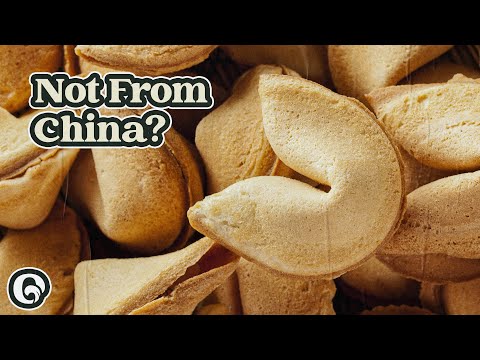
Who doesn’t enjoy a little wisdom with their Chinese meal? Well, perhaps the Chinese! That’s because fortune cookies are decidedly not a traditional Chinese custom brought to the United States. Nope! Clever American restaurateurs came up with this idea themselves. There are several stories about the fortune cookie’s invention, with two prominent claims, both originating in California in the early 20th century.
One account attributes the invention to Suyeichi Okamura, a Japanese immigrant, who supposedly created the fortune cookie in his San Francisco restaurant in 1906. Okamura claimed it was a modified version of a traditional Japanese treat that contained a prayer slip. He said he Americanized this concept and it took off.
Another claim comes from David Jung, a Chinese immigrant, who asserted he invented the cookie in his Los Angeles noodle shop in 1918. In a very American turn of events, the matter even went to court! In 1983, a judge in San Francisco’s Court of Historical Review was tasked with determining the fortune cookie’s origin. The judge ruled in favor of Okamura and San Francisco. While there wasn’t a major business interest at stake by then—fortune cookies were already widespread—the ruling settled the matter in the minds of San Franciscans, even if Los Angeles residents might still contest it. Regardless of which Californian city gets the credit, one thing is sure: fortune cookies are not authentically Chinese! [6]
4 Cuban Sandwich (Florida)

The Cuban sandwich is a culinary icon of Florida. Not only is it incredibly tasty, but it was also created in the Sunshine State. Many people, including some locals, might believe it came directly from Cuba, but that’s not quite accurate. Interestingly, a different type of “Cuban Sandwich” was popular in Havana over a century ago, featuring a Spanish-style sausage called salchichón. That sandwich remained a common dish for those who stayed in Cuba.
However, by the mid-19th century, many Cubans were moving to America, with Florida being a natural destination. It offered proximity to their homeland, a familiar climate, and communities of Cubans and other Spanish speakers. There was just one issue: these immigrants couldn’t find salchichón. The Spanish-style sausage was almost impossible to obtain in Florida.
By the 1880s, Cuban immigrants in Ybor City, Tampa, were busy rolling cigars. Local restaurant owners had the idea to substitute the hard-to-find sausage in their sandwiches with Genoa salami. The cigar rollers needed satisfying meals while they worked and were willing to pay for them. Since Italian salami was much easier to source in southwest Florida, restaurants began stocking it, and the local sandwich scene flourished.
This new creation eventually adopted the name of the people who loved eating it. Cooks tweaked the ingredients further, adding yellow mustard, Swiss cheese, and even pickles. Today, the salami base often remains, though roast pork and ham are also common components. It might not be directly from Cuba, but it’s undeniably delicious. From Tampa, it has spread worldwide, and the rest, as they say, is history. [7]
3 General Tso’s Chicken (New York)

Fortune cookies aren’t the only “Chinese” food item that’s actually an American invention. In fact, one of the most popular dishes on Chinese restaurant menus in the U.S. is entirely American-made! General Tso’s chicken is a staple across the country. This dish features dark-meat chicken that’s battered, fried, and coated in a sweet, tangy sauce, often served over broccoli and rice. It’s been a favorite for decades.
At least its name has some authentic roots: the chicken is indeed named after Zuo Zongtang (often spelled Tso Tsung-t’ang), a real historical Chinese military general and statesman from the Qing dynasty, who passed away in 1885. However, the genuine Chinese inspiration stops there. The dish itself was developed entirely in America.
A chef named Peng Chang-kuei worked for China’s nationalist government in the 1940s and was even a personal chef for Chiang Kai-shek. In 1949, during the Chinese Civil War, he fled to Taiwan. Two decades later, in 1973, he immigrated to New York City and opened a Chinese restaurant. One of his first creations was a new chicken recipe, which he named after Zuo Zongtang. He significantly sweetened the dish to appeal to American tastes, and this sugary-sweet chicken quickly became a sensation in the Big Apple.
Peng’s dish was an instant hit in America. Interestingly, when he later opened a restaurant near his birthplace in China’s Hunan province, General Tso’s Chicken didn’t do well. Chinese diners found it too sweet for their preferences, and the restaurant soon failed. Don’t feel too bad for Peng, though. His famous chicken recipe brought him fame and fortune for decades until his death in 2016. Now, the dish continues to be enjoyed nationwide. [8]
2 German Chocolate Cake (Texas)

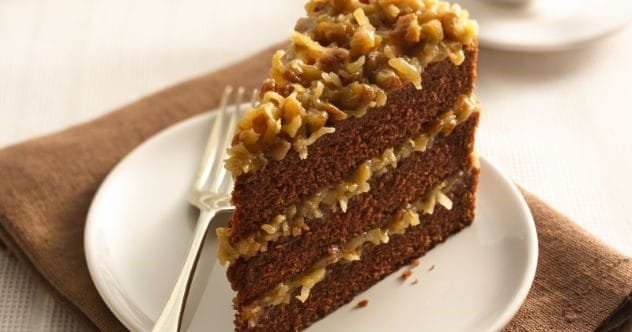
German chocolate cake isn’t named after the country of Germany, but rather after an American baker! Back in 1852, a confectioner named Samuel German developed a type of sweetened baking chocolate. His employers at Baker’s Chocolate Company were impressed with his creation, as it worked wonderfully in various chocolate baked goods.
They informed major food companies like Kraft and General Foods about their confectioner’s discovery. For many years, these large brands used German’s baking bars in their commercial products. The name stuck, too: Baker’s Chocolate Company honored Samuel by naming the bar after him. This legacy continued for decades but might have faded somewhat if not for a Texas homemaker.
Over a century later, in 1957, the recipe for a cake using this chocolate gained national attention. That year, Samuel German’s original ingredient list for the chocolate was part of a cake recipe printed in the Dallas Morning Star. A woman from a small town in Texas had submitted the recipe. Readers immediately fell in love with it. Soon, newspapers across the country picked up the story. Within months, Americans everywhere began buying Baker’s German’s Sweet Chocolate.
The company was thrilled with the unexpected surge in sales and started promoting the recipe. Samuel German had passed away many years earlier, but his baking bar suddenly experienced a revival. In the following decades, German chocolate cake became an American classic. Many who have baked or eaten it since might have associated it with Germany, but its origins are all-American! [9]
1 English Muffins (New York)

Like many items on this list, the English muffin drew inspiration from the country it’s named after. However, its creation in America came about through early immigration, necessity, and ingenuity. This story begins in 1894 with Samuel Bath Thomas, a New York resident. Thomas’s mother was British, and during her lifetime, she made a wonderful tea cake.
As the tale goes, young Samuel missed his mother’s cooking. While trying to recreate it in America, he developed a unique type of crumpet. His aim was to create a more “elegant” alternative to ordinary toast. And he succeeded, though perhaps not exactly as he initially intended. Still, Thomas’s leavened bread was so similar to a British crumpet that he first called it a “toaster crumpet.”
Almost instantly, Thomas’s toaster crumpet became a hit. Hotels and upscale restaurants in New York City began stocking his creation. Just as the British-born Thomas had hoped, these establishments saw it as a more refined version of twice-cooked bread. Soon, Thomas’s success led to the growth of the S.B. Thomas Bread Company.
In just a few years, his company became a leader among American bakeries, largely thanks to the popularity of his unique English muffin. Interestingly, these muffins took many decades to actually reach England. British consumers didn’t have domestic access to English muffins until the 1990s, when Thomas’s company was acquired by a larger conglomerate. This international brand then introduced English muffins to, well, England. With that, a supposedly “foreign” food truly came full circle! [10]
It’s clear that America’s culinary landscape is full of surprises! Many dishes we’ve come to associate with other countries actually have their roots firmly planted in American soil. These ten foods are a testament to the ingenuity and adaptability of immigrants and American cooks who blended old-world traditions with new-world ingredients and opportunities. The next time you enjoy one of these ‘foreign’ favorites, you’ll know you’re tasting a piece of true American history.
Which of these food origins surprised you the most? Do you know of any other ‘foreign’ foods that are actually American? Share your thoughts and foodie facts in the comments below!