Throughout much of human history, securing food was a daily struggle. Today, some in wealthy societies grapple with overabundance. Extravagant feasts became a way for the elite to flaunt their wealth, showcasing food in quantities that even reading about them can feel filling.
Here are ten of history’s most outrageous meals and the dishes served at them.
Vitellius’ Feast
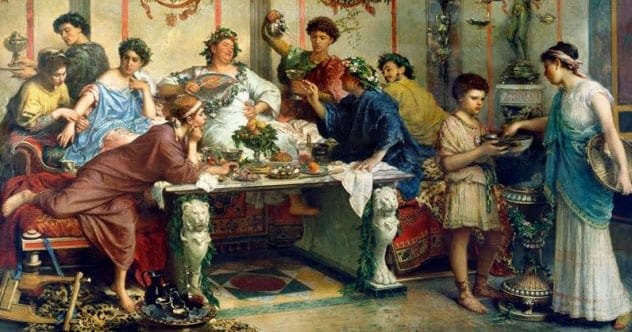
Roman orgies are legendary. While these feasts often included sexual antics, it was the sheer opulence of the food that shocked ancient historians. At the height of the Roman Empire, delicacies from thousands of miles away graced the tables of the wealthy, paired with rare wines. Emperor Vitellius elevated feasting to unprecedented levels of decadence.
Vitellius, a large man with an even larger appetite, won popularity with the army by showering them with food and drink. After Nero’s fall, he ascended to the imperial throne, ruling Rome’s dining tables for eight months.
The historian Suetonius recounts how Vitellius would schedule multiple meals a day with Rome’s richest citizens, each costing over 400,000 sesterces. To cope with this excess, he practiced frequent vomiting. His most infamous creation was the ‘Shield of Minerva,’ a massive dish containing “the livers of char-fish, the brains of pheasants and peacocks, with the tongues of flamingos, and the entrails of lampreys, which had been brought in ships of war as far as from the Carpathian Sea, and the Spanish Straits.”
Feast of the Pheasant
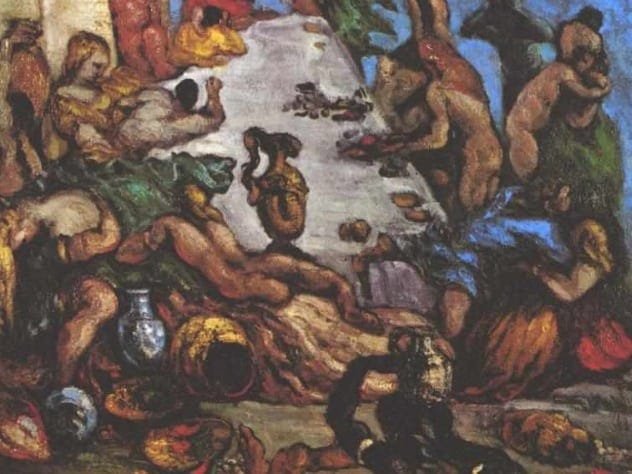
How do you rally support for war? In 1452, Philip the Good, Duke of Burgundy, hosted the Feast of the Pheasant, one of history’s most lavish banquets, to encourage a crusade against the Turks.
The feast hall was adorned with elaborate displays, including a model church housing a choir and 28 musicians hidden inside a pie. Fake ships sailed among the guests, and a live lion roamed a staged forest. A fire-breathing dragon soared overhead, and a young boy on a deer sang. The climax was an elephant, likely mechanical, led by a giant Turkish man, with a lady representing Constantinople pleading for rescue from atop the elephant.
After serving 50 different dishes, guests swore an ‘Oath to the Pheasant’ over a live bird, pledging to join the crusade to recapture Constantinople. However, no such crusade ever materialized.
The Acclimatisation Society of Great Britain

In the 19th century, many European intellectuals formed societies to introduce non-native species to new countries, believing they could benefit agriculture and society. Today, we recognize the dangers of invasive species. The Acclimatisation Society of Great Britain launched their campaign with a feast.
Guests were greeted by a hall decorated with stuffed birds, fish, and animal heads, showcasing potential imports. The meal highlighted how new species could enrich the nation’s dining tables.
The menu included birds’-nest soup (deemed unworthy of its cost), sea snail soup, boiled kangaroo, and a rare hare-rabbit hybrid. Dishes featured birds from Dominique, Syrian pigs, Honduras Turkey, diverse fish, and even seaweed jelly. Few, if any, of these dishes became staples in the English diet.
Regent’s Banquet
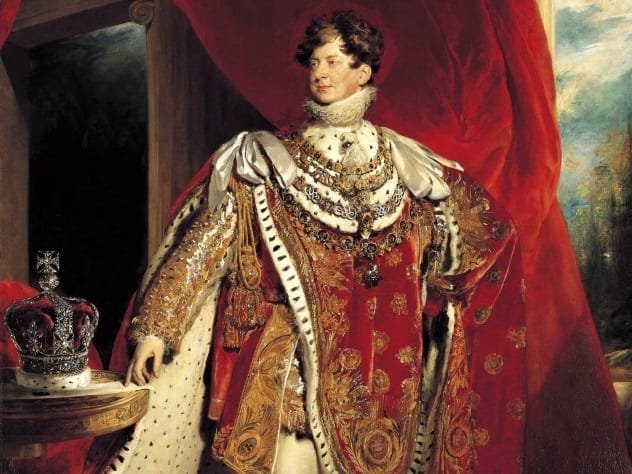
George IV had a lifelong fondness for luxury. As Prince of Wales, he accumulated £630,000 in debt (equivalent to £65,568,000 today). His father, George III, agreed to settle the debt on the condition that his son marry. As George III’s mental health declined, Prince George became regent, granting him more spending power.
He famously commissioned a flamboyant pavilion in Brighton. In 1817, the Regent hosted a feast for Grand Duke Nicolas of Russia, prepared by Marie-Antoine Careme, Europe’s first celebrity chef. Careme’s extravagant style perfectly matched the Regent’s tastes.
The banquet featured rice soup, sturgeon head in champagne, chicken in aspic, boar haunches, lark terrine, upside-down lemon jelly, truffles in warm linen, and a shrimp pyramid, among 121 other dishes. The Prince Regent may have been perpetually in debt but he was never in a caloric deficit.
Manchu-Han Feast

Sometimes, a single day isn’t enough for all the feasting you plan to do. The Manchu-Han Feast was so opulent that it supposedly took three days to serve, symbolizing Chinese unity.
Under Emperor Kangxi, tensions grew between the Manchu and Han factions. To unite them, the emperor believed that only an extraordinary meal could bridge the divide. For his 66th birthday, he hosted six banquets over three days, serving over 300 dishes.
Guests could savor Snowy Palm (bear claw with sturgeon) and Golden Eyes and Burning Brains (bean curd and bird brains). One dish was an “imitated leopard fetus,” though its ingredients remain a mystery. Simpler plates included grilled ape. While some scholars doubt its occurrence, many prefer to believe in, or dream about, attending such a feast.
The Fête at Vaux
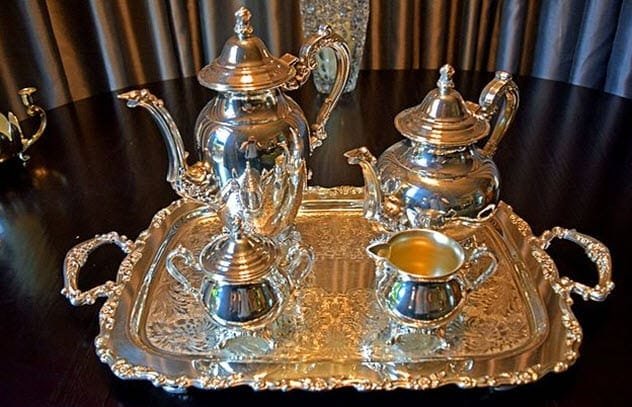
Few parties lead to political downfall, but Nicolas Fouquet’s 1661 fête sealed his fate. His celebration at Vaux-le-Vicomte, his lavish home, was so magnificent that King Louis XIV of France suspected Fouquet of embezzling from the royal treasury to fund it.
Fouquet, France’s finance minister, was already under Louis XIV’s suspicion. Yet, Louis accepted the invitation to Fouquet’s new château. Six thousand guests attended, causing miles-long traffic jams. The fête featured a new play by Moliere and showcased France’s finest art.
Guests dined from solid silver, while the royal family used solid gold plates. Dishes included pigeon pies, veal steaks stuffed with delicacies, and imported oranges. Actors dressed as fauns and elves gifted diamonds to the ladies. Voltaire remarked, “On 17 August, at six in the evening Fouquet was the King of France.”
Voltaire added, “But at two in the morning he was nobody.” Convinced of Fouquet’s embezzlement, the king had him arrested within weeks, and Fouquet spent the rest of his life in prison.
Banquet of Chestnuts
Sometimes, the entertainment at a feast overshadows the food. At the Banquet of Chestnuts, the events under the table were far more memorable.
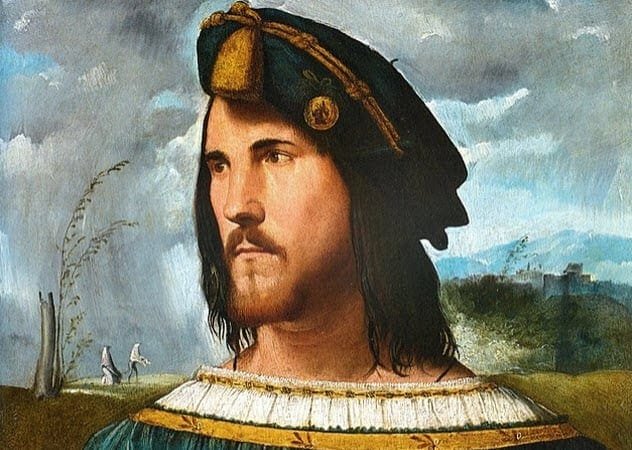
The Vatican isn’t known for its vibrant nightlife today, but there were times when Popes hosted extravagant, scandalous affairs. Pope Alexander VI, Rodrigo Borgia, belonged to one of Italy’s most infamous families. Though a celibate priest, he had children. His son Cesare hosted the Banquet of Chestnuts.
On October 31, 1501, Cesare hosted a banquet in the Papal Palace. According to the master of ceremonies, the party included “fifty honest prostitutes’ called courtesans, who danced after dinner with the attendants…at first in their garments, then naked…chestnuts were strewn around, which the naked courtesans picked up, creeping on hands and knees…while the Pope, Cesare, and his sister Lucretia looked on. Finally, prizes were announced for those who could perform the act most often with the courtesans…”
The Epicurean Masters of the World

Epicurean philosophers advocated for pleasure found in simplicity. For Epicurus, a pot of cheese was a treat. Yet, “Epicurean” has come to mean gluttony in pursuit of rare delicacies. In 2007, the “Epicurean Masters of the World” gathered in Bangkok.
For 1 million Baht (around £15,000) per person, guests enjoyed food by six chefs with three Michelin stars each. Using the finest ingredients, they created signature dishes. The feast began with crème brûlée of foie gras with Tonga beans, followed by Kobe beef tartar with Imperial Beluga caviar and Belons oyster. Each dish was paired with rare, expensive wines. Mousseline of pattes rouges crayfish with morel mushroom infusion was served with an Alain Soliveres 2000 Corton-Charlemagne.
The feast concluded with an extravagant gingerbread pyramid. And perhaps a bit of indigestion.
Raiding a Zoo
From September 1870, Paris was besieged by Prussian forces for four months. Instead of bombardment, the city was starved into submission. Food became scarce; Parisians ate thousands of horses, dogs, cats, and even rats. One restaurant offered a more exotic menu.
Alexandre Étienne Choron, a renowned chef, ran Voisin, famed for its exquisite food. As supplies dwindled, the Paris Zoo announced it would euthanize its animals due to lack of food. Choron seized an opportunity to serve an extraordinary Christmas meal.
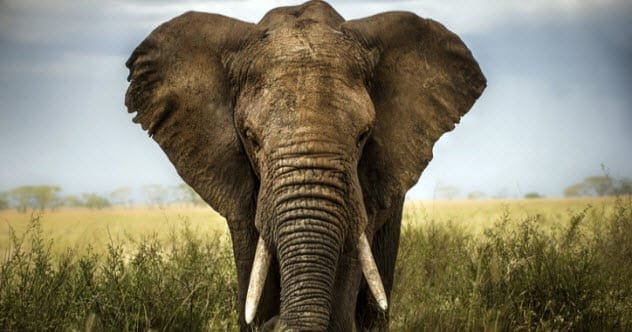
The feast began with a donkey’s head with sardines, followed by elephant consommé, fried camel, kangaroo stew, wolf with deer sauce, and antelope with truffles. Despite limited food supplies, Choron accessed Paris’ well-stocked wine cellars, pairing fine wines with these wild dishes.
Cleopatra
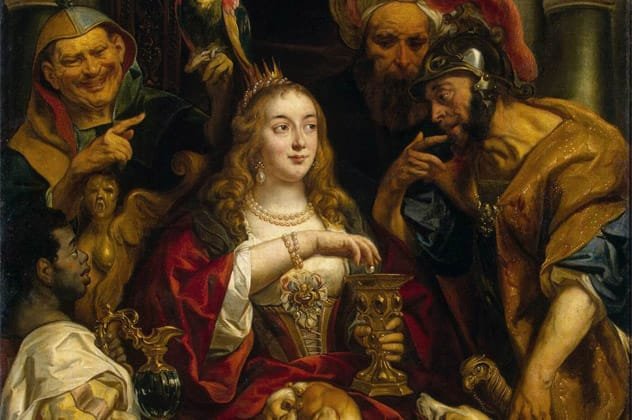
Cleopatra VII of Egypt was one of history’s most captivating women. Witty, educated, and seductive, she charmed both Julius Caesar and Mark Antony. Her rule over one of the wealthiest nations also played a part. Perhaps her cuisine drew Roman dignitaries to her palace.
The historian Plutarch wrote that his grandfather visited Cleopatra’s palace and saw her vast kitchens. Witnessing eight whole boars roasting, he assumed a grand feast was in preparation. Instead, he learned only 12 people were dining. The boars were cooked at different times, ensuring one was perfectly ready when guests sat down.
One feast was particularly extravagant. Cleopatra bet Antony she could spend 10,000,000 sesterces on a single meal. The served meal appeared ordinary, leading Antony to believe he had won. Cleopatra then called for dessert—a single bowl of vinegar. She owned two perfect pearls, worn as earrings. She removed one, dissolved it in the vinegar, and drank it, winning the bet.
Vinegar won’t dissolve a pearl, so some suggest Cleopatra won and kept her pearl, likely retrieving it from her chamber pot rather than the deep sea.
Which of these feasts would you attend? Leave your comment below!