Language is always on the move! It changes so much that sometimes it’s tricky to know what’s right or wrong. Have you ever used a saying and wondered if you got it quite right? Some phrases we use every day don’t mean what we think they do. These misunderstandings can even change the phrase’s common use over time! Get ready to explore 10 popular sayings and idioms that are often misunderstood. You might be surprised by their original meanings!
10 A Moot Point

Have you ever dismissed something by calling it a “moot point”? Many people use this phrase to mean an argument isn’t worth considering because it’s irrelevant. If someone says, “It’s a moot point whether we should have brought an umbrella, the rain has stopped,” they mean it doesn’t matter anymore. Some even mishear it as “mute point” or, like Joey from Friends, a “moo point” – like a cow’s opinion, which doesn’t matter!
However, the original meaning is quite different. The word “moot” actually dates back to the 11th century in England. It referred to a meeting for legal or decision-making purposes. Later, in the 16th century, a “moot” was a practice debate for law students, similar to a mock trial. So, a “moot point” was originally an issue that was uncertain and open for discussion and debate, not something irrelevant.
9 You Have Another Think Coming

If you’ve told someone “you have another thing coming,” you might want to think again! This common version actually comes from a mishearing of the original phrase: “you have another think coming.” The original saying, popping up in the early 19th century, meant that someone was wrong about something and needed to reconsider their opinion.
The “thing” version has become so popular that even the band Judas Priest used it in their 1982 song “You’ve Got Another Thing Comin’.” This type of phrase change is sometimes called an “eggcorn.” An eggcorn happens when a word or phrase is replaced by a similar-sounding one that still kind of makes sense in context. For example, someone might say “old-timers’ disease” instead of “Alzheimer’s disease.” Both get the point across, more or less!
8 One Fell Swoop

When something happens all at once, especially something sudden and destructive, you might say it happened in “one fell swoop.” But sometimes, people mistakenly say “one foul swoop.” This is another example of an eggcorn. While “foul” isn’t the original word, it does carry a similar negative feeling, so the mistake is understandable.
The original word, “fell,” means cruel, fierce, or terrible. It’s an older word we don’t use much today. The phrase is often linked to William Shakespeare, who used it in his play Macbeth around 1606. When the character Macduff learns his entire family has been killed, he cries out, “What, all my pretty chickens, and their dam / At one fell swoop?” The image is of a fierce bird of prey (a “hell-kite”) attacking a nest. Perhaps this bird imagery is why some people incorrectly use “fowl” (another word for bird) or “foul.”
7 A Rolling Stone Gathers No Moss

This famous saying has inspired songs, magazine names (Rolling Stone), and even a legendary band (The Rolling Stones). Today, many people use it to describe a free-spirited person who avoids settling down, like a traveler who doesn’t want a family or a steady career. In this view, not gathering moss (roots, responsibilities) is a good thing – it means freedom!
However, the saying originally had the opposite meaning! It was actually a warning about the downsides of being rootless and always on the move. The idea was that a person who doesn’t settle down doesn’t accumulate good things like wealth, status, or connections – much like a stone constantly rolling won’t allow moss to grow on it. This proverb became popular thanks to Erasmus’s Adagia, a collection of proverbs from 1500. For centuries, not gathering moss was seen as a negative. It’s only more recently that the interpretation has shifted to celebrate a bohemian lifestyle.
6 Great Minds Think Alike

When you and a friend have the same brilliant idea at the same time, you might exclaim, “Great minds think alike!” It’s a fun way to acknowledge a shared thought. This saying can be traced back to a 1618 play called Hans Beer Pot, His Invisible Comedy, which included the line “Good wits doe jumpe.” Here, “jumpe” meant to agree completely, an old usage of the word.
But there’s often a witty follow-up to this phrase that many people don’t know: “…fools seldom differ.” Adding this ending changes the tone quite a bit! It playfully suggests that while great minds might agree, so do those who don’t think much at all. The sentiment of this addition dates back at least to the 18th century. Thomas Paine, a famous writer during the American Revolution, wrote something similar, suggesting that only those who haven’t truly thought things through always seem to agree.
5 I Couldn’t Care Less

If you truly, absolutely do not care about something one bit, the correct phrase to use is “I couldn’t care less.” This means your level of caring is at zero; it’s impossible for you to care any less than you already do. However, you’ll often hear people say, “I could care less.”
If you think about it, “I could care less” actually means you do care, at least a little. If you could care less, it implies there’s still some amount of caring left to reduce. This mix-up is quite common. The correct phrase “I couldn’t care less” appeared in print around 1944, and its incorrect twin “I could care less” showed up just over a decade later. Despite being logically flawed, the incorrect version is widely used, sometimes defended as a form of sarcasm or just an idiom that doesn’t need to make strict sense.
4 Ye Olde

Walk down a historic-looking street, and you might see a shop sign that says “Ye Olde Sweet Shoppe” or something similar. This “Ye Olde” is meant to make things feel charmingly medieval or from a bygone era. But here’s a fun fact: it’s not really historically accurate, and we’re probably saying it wrong!
First, while spelling wasn’t standardized hundreds of years ago, “olde” wasn’t a super common way to spell “old.” Variations like “ole” or “auld” (as in Auld Lang Syne) were more typical. The bigger issue is with “ye.” That “y” isn’t actually a “y” sound. In older forms of English, writers used a letter called thorn (þ) to represent the “th” sound. Visually, the thorn (þe) looked a lot like a “y” next to an “e” (ye). So, “ye” in these contexts was just an old way of writing “the.” It should still be pronounced “the.” So, “Ye Olde Shoppe” really just means “The Old Shop.”
3 Begs the Question

You’ve probably heard someone say, “That begs the question…” meaning “That makes me wonder…” or “That raises an interesting point…” For example, if a new policy is announced, someone might say, “This new rule is supposed to save money, which begs the question of how much it will actually save.” This usage is incredibly common today.
However, this is a classic misunderstanding of the phrase’s original, more technical meaning. “To beg the question” originally described a specific type of flawed argument called circular reasoning. This comes from the ancient Greek philosopher Aristotle. Circular reasoning is when an argument’s conclusion is already assumed in its premise. For instance, saying “This book is good because it’s well-written” begs the question, as “well-written” already implies “good.” The Latin term for this is petitio principii, which was later translated into English as “begs the question.” So, technically, it means “assumes the conclusion without proof,” not “raises the question.”
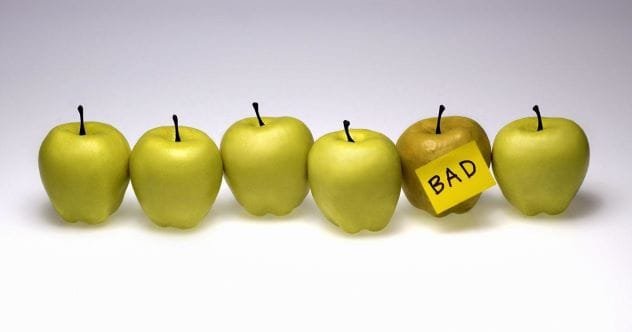
2 One Bad Apple

When people talk about “one bad apple,” they often mean that a single troublesome person is just an exception in an otherwise good group. For example, if one police officer does something wrong, someone might say they’re just “one bad apple,” implying the rest of the force is fine. This usage suggests the bad apple doesn’t affect the others.
But this is actually the opposite of the idiom’s original meaning! The full, older saying is “one bad apple spoils the barrel” (or “spoils the bunch”). This means that one corrupt or negative person can indeed have a damaging influence on the entire group around them. The idea is that badness is contagious. This proverb goes way back to the 1300s, even appearing in Geoffrey Chaucer’s The Canterbury Tales. And it’s true in real life: one rotting apple really can make the apples next to it start to rot too!
1 Pull Yourself Up by Your Bootstraps

This phrase is often used today as a motivational saying. It suggests that someone can achieve success through their own hard work and determination, without any outside help. “She really pulled herself up by her bootstraps to build that company.” It paints a picture of rugged individualism and self-reliance.
But take a moment and think about it literally: can you actually lift yourself off the ground by pulling on your own bootstraps? No, of course not! It’s physically impossible. And that’s precisely the point of the original saying. When this idiom first appeared around the 1830s, it was used sarcastically to describe an absurd or impossible task. It was meant to highlight something that simply couldn’t be done. Over time, this original ironic meaning has been lost, and the phrase now carries a completely different, more positive connotation.
It’s pretty amazing how language shifts and meanings can flip over time, isn’t it? These 10 sayings show us that words have rich histories. Knowing their original meanings can give us a new appreciation for the phrases we use. Sometimes, what we think is right is just a popular mistake, and other times, language simply grows and changes with us.
Which of these misunderstood sayings surprised you the most? Do you know any others that people often get wrong? Share your thoughts and examples in the comments below!