
Ever wonder where some of our everyday words come from? You might be surprised to learn that many common English terms have a direct line to the bustling streets, battlefields, and senate houses of Ancient Rome. While English is technically a Germanic language, it has a rich history of borrowing—or perhaps, enthusiastically adopting—vocabulary from Latin.
Join us as we journey back in time to explore ten words you probably use without a second thought, uncovering their fascinating, and sometimes startling, Roman origins. Get ready to see your vocabulary in a whole new light!
10. Decimate

When we say something has been ‘decimated’ today, we usually mean it’s been severely damaged or a large part of it has been destroyed. For instance, a town might be decimated by a hurricane. However, the original Roman meaning was terrifyingly precise.
Derived from the Latin word decem, meaning ‘ten’, ‘decimation’ was a brutal form of military punishment in the Roman legions. If a unit was found guilty of mutiny or cowardice, one in every ten soldiers would be randomly selected and then killed by their own comrades, often by clubbing or stoning. This harsh penalty was designed to enforce discipline and loyalty through extreme fear. So, while our modern use is broader, its ancient core refers to a very specific, grim culling of a tenth.
9. Circus

The word ‘circus’ today conjures images of clowns, acrobats, and trained animals under a big top tent. While the modern circus as we know it emerged in 18th-century England, the name itself travels much further back, to Ancient Rome.
The Latin word ‘circus’ relates to ‘circle’, referring to a round or oval-shaped venue. Roman circuses, like the famous Circus Maximus, were vast open-air arenas. But don’t expect to see juggling acts there! These circuses were stages for thrilling and often brutal spectacles like chariot races and gladiatorial combats. The spherical shape of these ancient venues is echoed in today’s circus rings, and the ‘ringmaster’ role still hints at this circular tradition. Though the entertainment has changed dramatically, the name persists.
8. Urine

This one might make you squirm a little! The English word ‘urine’ comes directly from the Latin ‘urina’. While we might consider this bodily waste product something to be quickly flushed away, the Romans had a surprisingly wide array of uses for it. In fact, it was so valuable that Emperor Nero even imposed a ‘urine tax’ in the 1st century AD!
Romans were quite inventive with urine. It was commonly used in tanning leather, but its ammonia content also made it an effective cleaning agent for laundry – Roman public laundries often collected it. Believe it or not, it was also used as a mouthwash and in toothpaste, as it was thought to whiten teeth! Furthermore, urine was employed as a form of invisible ink for secret messages, which would become visible when heated. This practice is even said to be the origin of the phrase ‘read between the lines’.
7. Triumph
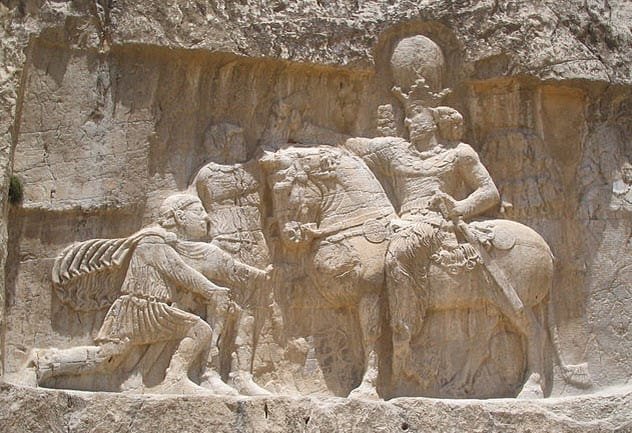
In modern English, ‘triumph’ signifies a great victory, success, or achievement. In Ancient Rome, a ‘triumph’ (triumphus in Latin) was a very specific and grand public ceremony and parade held to honor a victorious military commander.
The Roman Senate would grant a triumph only if certain strict criteria were met, such as inflicting at least 5,000 enemy casualties in a decisive battle. These events were incredibly lavish. The victorious general would ride in a chariot through Rome, displaying his spoils and captives. To keep his ego in check, a slave would often stand behind him, whispering, “Remember you are mortal.” Victories that didn’t quite meet the standards for a full triumph might be awarded an ‘ovation’, another term we still use for enthusiastic applause.
6. Rubicon
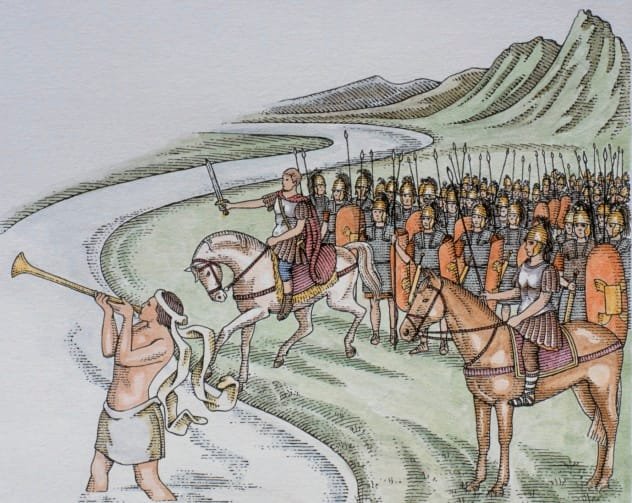
To ‘cross the Rubicon’ means to pass a point of no return, making a decision that irrevocably commits you to a particular course of action. This powerful idiom has its roots in a pivotal moment in Roman history.
The Rubicon was a small river in northern Italy that marked the boundary between the province of Cisalpine Gaul and Italy proper. In 49 BC, Julius Caesar, then governor of Gaul, was forbidden by Roman law from leading his army out of his province. When he defied the Senate and led his 13th Legion across the Rubicon and into Italy, he knowingly committed an act of treason, igniting a devastating civil war. This act forever cemented ‘crossing the Rubicon’ as a metaphor for taking a decisive, irreversible step.
5. Kaiser

Julius Caesar’s name became so legendary that it transformed into a title. ‘Kaiser’ is the German word for ’emperor’, and its lineage traces directly back to the Roman general and statesman. Similarly, the Russian title ‘Czar’ or ‘Tsar’ also derives from ‘Caesar’.
After Julius Caesar, subsequent Roman emperors adopted ‘Caesar’ as part of their imperial title, signifying their link to his power and legacy. Over time, as the Roman Empire’s influence spread and waned, the name, in its various forms, was adopted by rulers in other regions. The most well-known ‘Kaiser’ in recent history was Wilhelm II, the last German Emperor and King of Prussia, who led Germany into World War I. Though the title is no longer in use, its Roman origins are undeniable.
4. Plebeian

Today, calling something or someone ‘plebeian’ (or its shortened form, ‘pleb’) is often an insult, suggesting a lack of sophistication, or being common or vulgar. Think of how some might describe certain types of low-brow entertainment.
In Ancient Rome, however, ‘plebeian’ (from Latin plebeius) was a neutral term. It referred to the general body of Roman citizens, distinct from the privileged patrician (aristocratic) class, the senatorial class, or the equestrian class. Plebeians were the commoners—farmers, craftsmen, laborers. While not an insult originally, the term was later adopted, particularly by the class-conscious British in the 17th century, to denote the lower classes, which is how it acquired its negative connotations that persist today. The Roman emperors understood the power of the plebeians, using ‘bread and circuses’ (food and entertainment) to keep them content.
3. Salary

For most of us, ‘salary’ is a very welcome word, referring to the regular payment we receive for our work. But would you be happy if your paycheck came in the form of a common kitchen condiment? That’s precisely the ancient root of this term!
The word ‘salary’ comes from the Latin word salarium, which originally denoted the money given to Roman soldiers to buy salt (sal in Latin). In ancient times, salt was a precious commodity, essential for preserving food and for health. It was so valuable that it was used as a form of payment. This history is also why we use the expression someone is ‘worth his salt’, meaning they are competent and deserving of their pay. While salt is now inexpensive and readily available, its historical value is crystalized in the word ‘salary’.
2. Fascist

The term ‘fascist’ evokes images of authoritarian regimes and oppressive dictatorships. While Benito Mussolini is the modern figure most associated with popularizing fascism as a political ideology in the 20th century, the word’s symbolism goes back to Ancient Rome.
The term derives from the Latin word fasces, which was a bundle of wooden rods, usually with an axe bound in the middle. In Roman times, lictors (magisterial attendants) carried the fasces as a symbol of a magistrate’s power and authority to command and punish. The bundled rods symbolized strength through unity, while the axe represented the power over life and death. Mussolini’s Fascist party adopted the fasces as its emblem, drawing on this ancient Roman symbol of absolute authority to name its ideology.
1. Testify

Our modern legal systems owe a great deal to Roman law, so it’s no surprise that many legal terms have Latin roots. ‘Testify’, meaning to give evidence as a witness in a law court, typically under oath, is one such word, but its etymology has a particularly intriguing, if debated, origin.
The Latin word testis means ‘witness’. A popular, though not definitively proven, theory suggests that ‘testify’ is linked to the ancient Roman practice where men would swear an oath by placing a hand on their testicles. This part of the anatomy was seen as a symbol of virility and truthfulness, literally bearing witness to a man’s capacity to produce heirs and continue his lineage. While this specific custom is debated by etymologists, and other derivations from ‘testis’ as simply ‘witness’ exist, it’s a colorful (and perhaps slightly eye-watering) theory about what it once meant to truly stand by one’s word!
It’s fascinating how these words, born in a world so different from our own, continue to shape our language and offer glimpses into the past. The legacy of Rome is truly all around us, woven into the very fabric of our daily conversations.
What other words with ancient origins surprise you? Share your thoughts and any other Roman terms you find interesting in the comments below!