Have you ever watched a Planet of the Apes movie and wondered if such a world could ever exist? It sounds like pure science fiction, right? But what if the line between fiction and reality is thinner than we imagine? Recent events and scientific discoveries paint a startling picture. Let’s explore ten unsettling reasons why a world ruled by apes might not be so far-fetched after all.
1. Apes Are Super Smart!
“The proper study of apes is apes.” — Dr. Honorious (Planet of the Apes)
We often think of human intelligence as unique, but apes, especially chimpanzees, show remarkable smarts in ways that can surprise us. Researchers have found that chimps outperform humans in certain mental tasks. For instance, a chimp named Ayumu, born at Kyoto University, became a star in a computer memory game.
In this game, numbers 1 through 9 appeared randomly on a screen. After a brief look, players had to touch them in order. Ayumu and other chimps did incredibly well. When pitted against college students, the chimps were not only better but also much faster! Ayumu could recall the numbers’ positions in just two-tenths of a second with 80% accuracy, while students averaged only 40%. This shows chimps have fantastic short-term visual memory.
In another study, chimps played strategy games that involved predicting an opponent’s moves. The chimp pairs got closer to a perfect strategic balance, called the Nash equilibrium, than human teams. This might be because their strong non-verbal understanding makes up for a lack of spoken language. These mental skills help chimps survive, but unfortunately, they also use them for fighting.

2. Chimps Are Known to Make War with Each Other
“Ape not kill ape.” — Koba (Dawn of the Planet of the Apes)
When Jane Goodall first studied chimpanzees in Tanzania, she made groundbreaking discoveries. She saw them make and use tools, which was a big surprise. She also found they hunted and ate smaller primates, challenging beliefs that they were peaceful vegetarians.
But even more shocking was the Gombe Chimpanzee War, which started in 1974. This conflict broke out between two chimp communities when males from one group ambushed and killed a rival. Goodall witnessed the victors celebrating wildly. The war lasted four years, filled with brutality, murder, and kidnapping as territories shifted. She saw horrifying things, like one ape drinking blood from another’s wound. Male chimps often patrol their borders in large groups and will attack and kill males from neighboring communities. Their warfare can be as brutal as human conflicts, including acts like torture and genocide. This shared aggressive nature with humans might stem from a common ancestor, where such traits were key for survival.

3. Chimps Waging War on Gorillas
“Ape has never killed ape, let alone an ape child.” — Virgil (Battle for the Planet of the Apes)
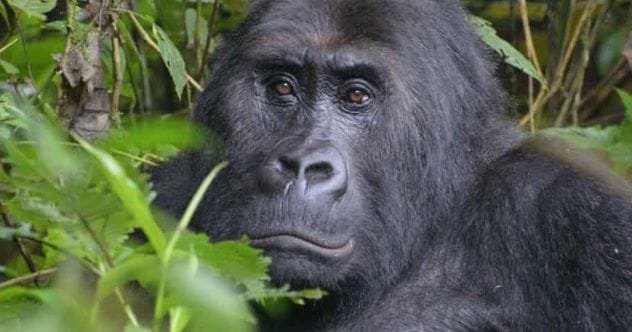
While chimps are known for fighting among themselves, attacks on gorillas were unheard of until recently. In Loango National Park in Gabon, a specific group of chimps has started targeting gorillas. These two ape species usually live peacefully side by side, even when they share food sources.
However, since 2019, the same band of 27 chimps has attacked smaller groups of western lowland gorillas twice. In both instances, male gorillas fought bravely but were outnumbered. Tragically, both attacks ended with an infant gorilla being killed. One of the baby gorillas was even eaten by the attacking chimps. Researchers wonder if the chimps mistook the baby gorilla for a small monkey, which they sometimes eat. But other reasons seem more likely. Global warming is making fruit harder to find in Gabon’s rainforests, leading to more competition for food. Both attacks happened when fruit was scarce and during chimp border patrols. This suggests these attacks are part of their ongoing turf wars, but this time, gorillas are the victims. This is a new and worrying development.

4. Chimps Waging War Against Man
“The only good human is a dead human!” — General Ursus (Beneath the Planet of the Apes)
As forests shrink, chimpanzees in western Uganda are increasingly clashing with humans, and they often target the most vulnerable: children. In 2014, in a village called Kyamajaka, a chimp jumped into a family’s garden and snatched a two-year-old child. Though villagers chased them, the chimp tore off the child’s arm and ripped out his kidneys before he could be rescued. The boy died on the way to the hospital.
This tragic incident is part of a larger pattern. Chimps raid crops planted on their former territory and attack the humans who tend them. This area of Uganda has a history of chimp attacks on children. Since the 2014 attack, three more children have died, and several others have been injured. As farming expands into rainforest areas, these attacks are likely to continue. Chillingly, it’s illegal to shoot a chimpanzee in Uganda, even in self-defense. Similar attacks occur in the Congo, where children have been killed or severely disfigured by chimps as their habitats diminish.

5. Don’t Pick a Fight with a Chimp
“Take your stinking paws off me, you damn dirty ape!” — Taylor (Planet of the Apes)
Chimpanzees are our closest relatives, sharing 98.8% of our DNA. That remaining 1.2% must pack a punch, because an angry adult chimp is a force to be reckoned with! A large male can weigh up to 150 pounds and stand over five feet tall. They are about 1.5 times stronger than an average man.
With their sharp canine fangs and claw-like nails on what are essentially four hands, chimps fight brutally. They’re known to rip off faces, scalps, hands, and genitals. When enraged, they enter a frenzy that’s hard to stop without extreme measures. It’s practically impossible for a human to win a hand-to-hand fight with an adult male chimp. Experts advise that if you face an attack, your best bet is to jump into water, as chimps are poor swimmers.
Interestingly, you’d be safer angering a male gorilla. Gorillas are much larger and stronger but are generally peaceful and rarely attack unless threatened. Orangutans are even more docile. Bonobos, who look like chimps, are also less aggressive and often turn tense situations into sexual encounters. If humans ever did go to war with apes, chimpanzees would undoubtedly be the fierce front-line soldiers.

6. The Dark Nature of the Beast
“They’re hideous creatures.” — Albina (female mutant, Beneath the Planet of the Apes)
Chimpanzees can be intelligent, social, and playful. Yet, they can instantly turn into terrifying killing machines, even against those they once respected. Alpha males and elders hold authority, but if they lose popularity, they risk being attacked and even murdered by their own group. Jane Goodall was haunted by the memory of a younger male savagely beating a fallen, elderly former alpha he once looked up to.
In 2013, a former alpha male chimp named Foudouko was brutally killed and cannibalized by the males he once led. He had lived alone for years and was met with a cold reception when he returned seeking companionship. This dark side also makes them unsuitable as pets. Many have heard of Travis, a pet chimp who, in 2009, viciously attacked his owner’s friend, tearing off her face and hands. The victim survived but was permanently disfigured. Sadly, this isn’t an isolated event. Infanticide is also a grim reality in chimp communities, sometimes used by males to bring females back into their reproductive cycle sooner. Chimps seem capable of profound intelligence yet also commit the darkest acts, sometimes surpassing even human cruelty.

7. The Gift of Gab
“What the hell would I have to say to a gorilla?” — Brent (Beneath the Planet of the Apes)
Scientists have long tried to teach apes human languages, like sign language or symbolic systems. While some apes, like Koko the gorilla or Kanzi the bonobo, learned many words, their language skills never surpassed that of a human toddler. Linguists now view these early claims with skepticism, suggesting the apes were often just mimicking for treats rather than truly understanding sentence structure or grammar.
A chimp named Nim Chimsky, ironically named after a linguist who doubted primate language studies, seemed to be a bit of a con artist. He learned that if he randomly signed words, including the sign for “banana,” researchers would assume he was asking for one and reward him. Smart, but not quite Shakespeare. Apes don’t need our complex languages; they communicate effectively in their own ways. They use gestures, facial expressions, body posture, and even smells to convey messages. While gorillas and orangutans are often quiet, angry chimps have no trouble loudly hooting and screeching their intentions. A crucial difference is that humans record history and plan for the future, while apes live entirely in the present. Perhaps in a conflict, we’d benefit more from understanding their communication than trying to teach them ours.

8. Chimps Entering the Stone Age
“It was at this level I discovered cutting tools and arrowheads of quartz…” — Cornelius (Planet of the Apes)
Have chimpanzees entered their own Stone Age? It’s a hot topic among scientists. We know they use rocks to crack nuts and throw them at enemies. Archaeologists in the Ivory Coast even found stone hammers that fit chimp hands and had residue from nuts they eat. These tools predate human presence in the area by about 2,000 years, meaning the skill was passed down for roughly 200 chimp generations.
However, not all experts agree. Some studies show chimps struggle to make sharp tools on their own, even with incentives. When given stone cores and hammers to create tools to get food from a sealed container, they couldn’t figure it out independently, though they had some success after watching humans do it. The fact they seem unable to create complex stone tools beyond simple smashing makes some researchers conclude they haven’t reached a simian Stone Age. Still, the idea of apes learning to make even basic weapons, perhaps led by a revolutionary figure like Caesar from the movies, is a sobering thought.

9. A Simian God?
“Beware the beast Man, for he is the Devil’s pawn. Alone among God’s primates, he kills for sport or lust or greed.” — The Lawgiver (Planet of the Apes)
Do apes believe in a higher power? For a long time, spirituality was considered uniquely human. However, recent observations suggest chimpanzees might have their own early forms of religious behavior. Scientists have seen chimps in Africa building stone shrines and performing ritual-like dances during rainstorms. These actions don’t seem to have any practical purpose, much like ancient human rituals performed at spiritual ceremonies.
These behaviors in early humans were the beginnings of organized religion. There’s no strong reason to think differently about similar rituals performed by chimps today. If chimps are indeed on their own spiritual journey, it adds another layer of complexity to their nature. Considering how many human wars have been fought in the name of religion, the thought of chimps developing their own divinely inspired motivations, perhaps even a ‘holy war’ against humans, is quite alarming.

10. Our Role in Creating a ‘Forbidden Zone’
“The Forbidden Zone was once a paradise. Your breed made a desert of it…ages ago.” — Dr. Zaius (Planet of the Apes)
Remember the desolate ‘Forbidden Zone’ from the movies? We might be unintentionally building it right now. Climate experts tell us our planet is heating up, with extreme weather becoming more common. This isn’t just bad luck; scientific studies show human actions are a big part of the problem.
Think about deforestation. In places like the Amazon, huge areas of rainforest vanish each year. In Africa, vast stretches of fertile land have turned into desert. This destruction isn’t just an environmental issue. It shrinks animal habitats, forcing different species, including apes and humans, into closer, often conflicting, contact over dwindling resources. As habitats shrink and global warming intensifies, competition for food and space grows fiercer. This environmental pressure could be the catalyst for wider conflict, potentially pushing apes into a desperate struggle for survival against humans. Will we see armies of apes rising up to reclaim what they’ve lost due to our actions?

The evidence is compelling, and frankly, a little unsettling. From their surprising intelligence and complex social structures to their capacity for warfare and tool use, chimpanzees and other apes possess many traits that could, under the right (or wrong) circumstances, mirror the dramatic scenarios of Planet of the Apes. While a full-scale ape takeover might still seem like a distant sci-fi plot, the ongoing environmental changes and increasing conflicts at the human-ape interface remind us that we share this planet. Understanding these powerful primates and respecting their world is more crucial than ever.
What do you think? Are these signs a cause for concern, or is it all just Hollywood hype? Share your thoughts in the comments below!