Geography, often relegated to dusty textbooks and childhood memories, holds a treasure trove of fascinating and often bizarre facts. Whether you loved it or loathed it in school, geography shapes our understanding of the world. In an age where GPS navigation has replaced our innate sense of direction, a basic knowledge of geography remains invaluable. Prepare to amaze your friends with these ten strange but true geography facts that go beyond the basics.
10. Straddling Continents

Istanbul, Turkey, holds the unique distinction of being the only city in the world located on two continents. This remarkable feat is due to the Bosphorus Strait, a natural waterway connecting the Black Sea to the Sea of Marmara. West of the Bosphorus lies Europe, while to the east stretches Asia. Imagine standing in the heart of Istanbul, simultaneously straddling two continents!
The Bosphorus Strait is a major tourist attraction. Visitors flock to Istanbul to experience this geographical marvel, taking boat trips to witness the continental divide firsthand. A simple turn of the head reveals Europe on one side and Asia on the other, making Istanbul a truly unique city.
9. What’s in a Name?

The world is filled with places boasting unusual names. Among them, Batman (Turkey) stands out. A sizable city with approximately half a million residents, it sparks humorous comparisons with Gotham, Wisconsin. While Gotham is much smaller, one can’t help but wonder about the presence of a Bruce Wayne there.
Norway features a village named Hell. Despite its name, this waterfront village a few hundred miles north of Oslo is likely nothing like the fiery underworld. Michigan, USA, also has a village named Hell, home to 72 residents. But the ultimate trifecta of strange place names belongs to Boring (Oregon, USA), Dull (Scotland), and Bland (Australia). These locales have been humorously dubbed the “Trinity of Tedium,” proving that geography can indeed be fun.
8. Deserted Deserts

The largest desert in the world isn’t the Sahara or the Gobi; it’s Antarctica. This icy continent spans about 5.5 million square miles (14.2 million square kilometers), making it the largest and coldest desert on Earth. Temperatures there have plummeted to a chilling -128°F (-88.9°C).
Despite its size, Antarctica isn’t the driest place on the planet. That title belongs to the Atacama Desert in Chile, which receives a mere 0.03 inches (0.076 cm) of average annual rainfall. Its extreme dryness has made it a valuable site for NASA scientists studying ecosystems on barren planets like Mars.
7. Canada’s Endless Coasts

Canada boasts the longest coastline of any country in the world, totaling 151,000 miles (243,042 kilometers). This massive figure is due to Canada’s extensive territory and numerous islands, both large and small, scattered across its northern regions. The next closest contenders, such as Indonesia, Russia, the United States, and China, don’t even come close!
Furthermore, Canada is home to the most lakes in the world. With about 879,800 lakes, Canada contains more freshwater bodies than all other countries combined, holding over 60% of the world’s 1.4 million lakes.
6. Ride the Dutch Way

The Netherlands is a nation where bicycles outnumber people. With approximately 18 million residents and 22 million bicycles, there’s more than enough to go around. This isn’t just a quirky statistic; it’s a testament to the Netherlands’ commitment to sustainable living.
Cities like Amsterdam prioritize walkable and bikeable communities. Biking is often easier than driving in urban areas. This focus on green living has created a strong biking culture, promoting exercise and fresh air.
5. No Volcano? No Problem!

Australia stands alone as the only continent without an active volcano. Even Antarctica has active volcanoes like Mount Sidley and Mount Erebus. Australia’s unique geological stability is due to its location in the middle of the Indo-Australian Tectonic Plate.
This central position shields Australia from the earth’s movements, sparing the continent from volcanic activity. Ironically, neighbors like Papua New Guinea and Indonesia, located along the edges of the Indo-Australian Tectonic Plate and within the Pacific Ring of Fire, constantly grapple with volcanic threats.
4. Staying on the Surface

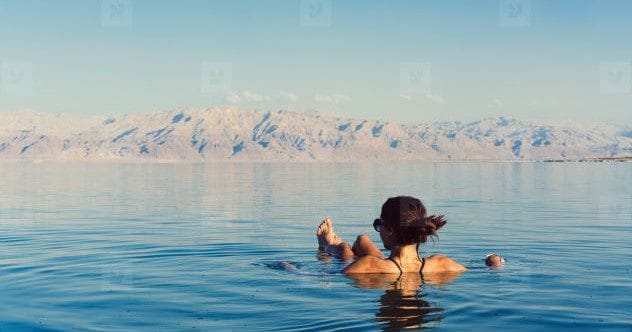
The Dead Sea’s extreme salinity allows people to float effortlessly on its surface. Despite its name, the Dead Sea is actually a hypersaline lake, containing a high concentration of sodium chloride and other minerals, making it nearly ten times saltier than the ocean. It is also the lowest point on Earth.
The water’s unique density allows swimmers to float without any effort. You can even read a book while floating! Although the salt content won’t harm you, it’s best not to ingest the water.
3. Russia Runs on and on…

Russia is the largest country in the world, covering approximately 6.6 million square miles (over 17,125,000 square kilometers). This vast area accounts for more than one-eighth of the world’s entire land area. In comparison, the United States covers about 3.8 million square miles (9.8 million square kilometers).
Due to its massive size, Russia spans eleven time zones, the most of any country. When it’s dawn in Moscow, it’s dusk in the Far East. Russia also shares borders with sixteen other nations, the most of any country on Earth.
2. No Water for You!

A “doubly landlocked” country is not only landlocked itself but also bordered exclusively by other landlocked countries. Only two countries fit this description: Liechtenstein in Western Europe and Uzbekistan in Central Asia. This geographical predicament poses significant challenges for international trade.
Liechtenstein is surrounded by Austria and Switzerland, while Uzbekistan is bordered by Afghanistan, Kazakhstan, Kyrgyzstan, Tajikistan, and Turkmenistan. This lack of access to any coastline can hinder economic development.
1. Way out West

Reno, Nevada, is located further west than Los Angeles, California. It seems counterintuitive, given that Los Angeles is on the Pacific coast, but Reno sits at 119°49′ West, while Los Angeles is at 118°14′ West.
This surprising fact is due to the curvature of the southern California coastline. Despite being inland, Reno enjoys slightly later sunsets than Los Angeles.
These ten geography facts reveal the world’s fascinating and often surprising nature. From cities straddling continents to deserts of ice, geography offers endless opportunities for discovery. Hopefully, these tidbits have sparked your curiosity and provided some fun trivia to share.
What’s the most surprising geography fact you’ve ever heard? Leave your comment below!