Our modern world runs on industry. This progress helps countries grow. But what happens to the leftover stuff? We call it industrial junk. This waste can’t just disappear. It often creates huge problems for our planet. Some places have become giant graveyards for specific types of junk. Let’s explore ten of these amazing and strange industrial graveyards around the world.
10. Tire Graveyard, Sulabiya, Kuwait

Imagine a place so full of old tires that you can see it from space! That’s the Sulabiya tire graveyard in Kuwait. This enormous black patch in the desert holds over 50 million tires. It makes you wonder where all these tires came from and why they are all here.
The story starts back in the 1980s. For about two decades, Kuwait imported used tires from all over the world, especially from countries like the U.S. and Europe. It offered a place for these countries to get rid of their unwanted rubber. But by 2001, the pile of tires had grown so massive that Kuwait had to stop taking any more.
Now, Kuwait faces the huge task of dealing with these 50 million tires. They are trying to recycle them and even make some money, but there are just too many. Worse, these tire piles often catch fire. These fires are very hard to put out and cause terrible pollution, harming the environment in a big way.
9. Car Graveyard, Old Car City, Georgia, USA

Next up is a graveyard filled with history on wheels. Old Car City in Georgia, USA, is home to over 4,500 vintage cars and trucks. This makes it the world’s largest graveyard for classic automobiles. It first opened its gates in 1931, not as a museum, but as a junkyard.
Originally, the main business was collecting scrap metal from old cars. This became especially important during World War II when metal was in high demand. Over the years, however, Old Car City became famous for its collection of older car models, mostly from 1972 or earlier.
Today, this unique junkyard also serves as an outdoor museum. People travel from all over to see these amazing American classic cars, slowly being reclaimed by nature. It’s a popular spot for photographers and car enthusiasts alike, offering a rusty glimpse into automotive history.
8. E-Waste Graveyard, Agbogbloshie, Ghana

In our digital age, electronic waste, or e-waste, is a growing problem. We love our smartphones, computers, and gadgets, often upgrading them yearly. This leaves behind millions of tons of old devices. While some e-waste is recycled, a lot of it needs to be discarded.
Sadly, wealthy nations often send their e-waste to poorer countries. Agbogbloshie in Ghana became the world’s largest e-waste dumpsite. Around 50 million tons of e-waste are generated globally each year. At Agbogbloshie, about 10,000 local workers used to sort through this junk. Some usable items were sold cheaply, while workers extracted valuable metals from other items using dangerous methods like acid and fire. This process released harmful toxins, badly affecting people’s health.
Recently, the Ghanaian government cleared the Agbogbloshie site, including its recycling center and market. However, the e-waste still arrives, and the risky recycling work has reportedly moved to hidden locations, often closer to where people live, continuing the health hazards.
7. Plastic Jungle Graveyard, Malaysia

Plastic waste is a tough problem for almost every country. Malaysia once tried to build a business around importing plastic waste from around the globe. The plan was to turn this waste into new, marketable products. This quickly made Malaysia a major destination for the world’s plastic junk.
However, just like other countries that tried similar ventures, Malaysia found itself overwhelmed. The sheer amount of imported plastic became too much to handle. The benefits of the business shrank as the mountains of waste grew taller. Treating all that plastic turned into a massive challenge.
As a result, Malaysia has started to send unwanted plastic waste back to the countries it came from, particularly in Europe. Now, Malaysia is left with the difficult job of managing the large stockpiles of plastic already on its land. Finding an easy solution to this plastic jungle is proving very hard, and the longer it stays, the more it threatens the environment.
6. WWII Bombs Graveyard, Beaufort’s Dyke Submarine Trench

World War II left behind a massive amount of unexploded bombs. After the war ended, the Allied nations needed to dispose of them safely. The United Kingdom government chose a deep underwater trench in its waters called Beaufort’s Dyke for this task.
Beaufort’s Dyke is a 31-mile-long trench located in the North Channel, between Northern Ireland and Scotland. It’s believed that the UK began dumping munitions here as early as the 1920s and continued until 1976. An estimated 1.15 million tons of conventional and chemical bombs now rest in this trench, making it the world’s largest underwater bomb graveyard.
Experts worry that these aging bombs are like a ticking time bomb. As the bomb casings corrode over time, they could explode. This danger has stopped plans for a bridge between Ireland and Scotland. Sometimes, bombs from the trench even wash up on nearby shores. If this massive undersea arsenal were ever to detonate, the consequences could be devastating.
5. Alang Shipyard, Gujarat, India

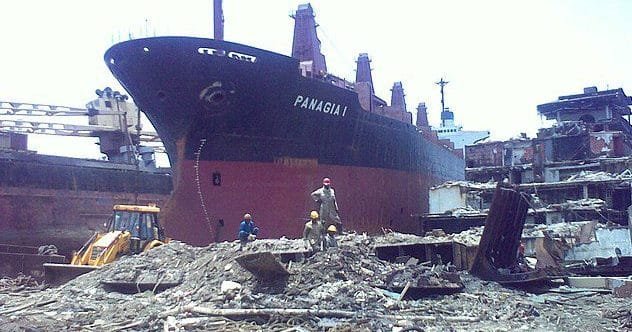
Every mighty ship eventually reaches the end of its service. When ships are too old or no longer useful, many are sent to ship-breaking yards. Here, these once-grand vessels are torn apart piece by piece, mostly for their metal.
The Alang Shipyard in Gujarat, India, is one of the world’s largest graveyards for ships. Each year, between 400 and 500 ships arrive at Alang to be dismantled. The coastline is dotted with ships in various stages of deconstruction, looking like half-eaten giants. The constant clang of metal is a defining sound of Alang, along with the ocean waves.
While ship-breaking is a multi-billion dollar industry, it comes at a cost. Toxic materials from the ships, like asbestos and heavy metals, often pollute the surrounding environment, severely harming marine life. A visit to Alang can feel like attending a funeral for these colossal machines.
4. Clothes Dumping Site, Atacama Desert, Chile

In the barren Atacama Desert in Chile, near the port city of Iquique, lies a truly shocking sight: mountains of discarded clothes. This area has become a graveyard for fast fashion, receiving around 60,000 tons of unwanted clothing each year. Chile is one of the largest importers of used clothing in Latin America.
About 40% of these imported used clothes are resold in poorer Latin American countries. However, the clothes that don’t find a buyer, even when sold by weight, end up dumped in the Atacama Desert. These growing mounds of fabric include everything from high-end fashion labels to cheap, quickly made garments.
This vast clothing graveyard is a stark symbol of our throwaway culture and mindless consumerism. The sheer volume of textiles highlights the environmental impact of the fast fashion industry, which encourages frequent purchases and quick disposal of garments.
3. Nuclear Waste Graveyard, Hanford Nuclear Site, Washington, USA

The Hanford Nuclear Site in Washington State covers a vast area of 586 square miles near the Columbia River. During the Cold War, this facility was crucial for producing plutonium for nuclear weapons. In fact, about two-thirds of the plutonium for the U.S. nuclear arsenal came from Hanford.
Today, the Hanford Site serves as a massive nuclear waste graveyard. It stores around 56 million gallons of liquid nuclear waste in large underground tanks. Solid nuclear waste is also buried underground. This waste remains dangerously radioactive for many, many years. There have been reports of some storage tanks leaking their hazardous contents.
Workers at the Hanford Site have reported serious health problems, including cancer, linked to their employment there. As the largest nuclear waste graveyard in the U.S., Hanford poses a significant risk. Any major spill or accident could lead to an environmental disaster with far-reaching consequences.
2. Spacecraft Graveyard, Point Nemo, Pacific Ocean

Space exploration is a symbol of human achievement. But even this noble pursuit creates its own kind of junk. Old rockets, decommissioned satellites, and damaged spaceships all become space debris. This junk can’t be left floating around Earth, as it would pose a threat to future space missions.
So, where does all this high-tech trash go? Scientists identified the most remote place on Earth as a dumping site for spacecraft. This spot is called Point Nemo, located in the South Pacific Ocean. It’s the point on Earth farthest from any landmass.
The extreme remoteness of Point Nemo makes it ideal for this purpose. When a spacecraft re-enters Earth’s atmosphere, it gets incredibly hot, and parts of it can survive the fiery descent. By aiming for Point Nemo, space agencies minimize the risk of falling debris hitting anyone or anything. If you could dive to the seabed there, you’d find the remains of many famous spacecraft resting in their deep-sea graveyard.
1. Glass Beach, Ussuri Bay, Russia

Our final stop is a place where human carelessness was transformed by nature’s artistry. Ussuri Bay in Russia, a 42-mile-long stretch, was once a dumping ground for a nearby glass factory and for locals discarding empty bottles. Truckloads of waste glass and porcelain were thrown into the bay for years.
This thoughtless dumping turned a beautiful bay into an ugly, dangerous mess of broken glass. But then, Mother Nature stepped in with a remarkable cleanup plan. Over many years, the constant motion of the tidal waves in the bay slowly tumbled and eroded the sharp pieces of glass.
The result is stunning. The once-sharp shards have been smoothed into colorful, jewel-like pebbles. The entire beach now shimmers with these glass ‘gems,’ looking like a rainbow has spilled onto the shore. Ussuri Bay’s Glass Beach is now a popular tourist destination, where people come to marvel at how nature turned trash into treasure.
These ten spots show us a surprising side of our industrial world. We see mountains of tires and deserts of clothes. These places remind us how much stuff we use and throw away. Some sites, like Glass Beach in Russia, show nature’s power to make something beautiful from trash. But many others are serious warnings. They make us think about how we can live better and waste less.
What do you think about these strange resting places for industrial junk? Share your thoughts in the comments below!