Some people drink, some don’t. However, almost everyone has a story about partying with friends, whether at a bar or a wild get-together. These tales of laughter, crazy antics, and maybe a few regrets unite us. Accounts of revelrous partying, fueled by beer, wine, and spirits, have been recorded worldwide throughout history. As far back as prehistoric times, drinking likely occurred wherever wild grapevines, apple trees, or berry bushes naturally fermented.
So, let’s dive into some spirited moments and themes highlighting the ongoing, popular pastime of group inebriation!
Tipsy Birds and Bees

Alcoholic fermentation happens when microorganisms, like yeast, break down glucose and fructose in sugary fruits and berries, producing ethanol and carbon dioxide. While plants enjoy the carbon dioxide, animals seem to love the ethanol!
Bohemian waxwing birds in northern forests gorge themselves, sometimes together in large flocks, on fallen fruits and berries that have fermented—nature’s version of Jell-O shots. While most handle their buzz, many overindulge, staggering through the sky and crashing into things.
Honey bees in Australia sometimes drink fermented nectar, leading to chaotic swarms. If they make it back to the hive, guard bees often kill them to protect the honey’s purity. Red-collared lorikeet parrots also party with fermented flower nectar from the Weeping Boer-bean tree, often falling from branches. Don’t exceed your limit when perched!
Some critters fit right into our modern world. Vervet monkeys on St. Kitts raid bars for unattended beer and cocktails, then party in the palm trees. In 1974, in West Bengal, India, a herd of about 150 elephants drank moonshine after breaking into a still. They rampaged, trampling huts and buildings, killing five people. Talk about a rough morning after!
Stumbling Through Ancient History

The first apple might have gotten Adam and Eve kicked out of the Garden of Eden, but they likely made cider afterward.
In 2018, archaeologists in Israel found a 13,000-year-old Stone Age brewery. Its owner was probably a popular hunter-gatherer. The beer was likely consumed at ritual feasts, supporting the theory that beer brewing motivated early cereal crop planting in the southern Levant.
The Natufians, who lived during the Late Epipalaeolithic period, understood beer making, suggesting they planted seeds to make more beer and host more feasts. Fast forward 10,000 years, and an ancient Egyptian inscription from 2200 BC says, “the mouth of a perfectly contented man is filled with beer.” They celebrated the Tekh Festival, mandating inebriation in honor of Hathor, the goddess of fertility and drunkenness. The Bast Festival encouraged women to drink, dance, and show off—unusual behavior that probably encouraged pregnancy.
The ancient Greeks held drinking parties, or symposia, for the sake of drinking. These all-male events featured intellectual conversation and ostentation. Wine flowed, and parties got rowdy. A favorite game was slinging wine across the floor. Greek vases suggest erotic encounters with hired women and sometimes men.
One famous symposium in 416 BC focused on moderation, as attendees were hungover from the previous night. Socrates gave a long speech, concluding at sunrise with everyone asleep. Historians wonder if they chose intemperance or if Socrates was just long-winded.
The Wedding at Cana Controversy

“There was a marriage in Cana of Galilee: and the mother of Jesus was there. And Jesus also was invited, and his disciples, to the marriage. And the wine failing, the mother of Jesus saith to him: They have no wine. And Jesus saith to her: Woman, what is that to me and to thee? my hour is not yet come. His mother saith to the waiters: Whatsoever he shall say to you, do ye. Now there were set there six waterpots of stone…Jesus saith to them: Fill the waterpots with water…And Jesus saith to them: Draw out now, and carry to the chief steward of the feast…And when the chief steward had tasted the water made wine…the chief steward calleth the bridegroom, And saith to him: Every man at first setteth forth good wine…But thou hast kept the good wine until now. This beginning of miracles did Jesus in Cana of Galilee…” (John 2:1-11 DR).
Some Christians believe Jesus wouldn’t create wine from water, citing Bible verses that forbid drinking. They argue the water turned into grape juice due to translation ambiguities. The Greek word “oinos” can mean both wine and grape juice, and it translates from Hebrew words with similar ambiguity. However, historians note that without refrigeration, Hebrews primarily stomped grapes to make wine.
Educated theologians argue the wedding at Cana occurred early in Jesus’ ministry. It was a Jewish wedding, and wine was a staple. Wine enthusiasts note that the governor of the feast praised the serving of good wine last, referring to the practice of offering finer vintages early to intoxicate guests before serving the “crappy stuff.” Mary wouldn’t have asked Jesus to replenish unfermented grape juice—people panic when the booze runs out!
So, Jesus attended a drinking party and contributed. He grew up learning the words of Isaiah: “Let us eat and drink; for tomorrow we shall die.”
The Romans Threw One Hell of a Party

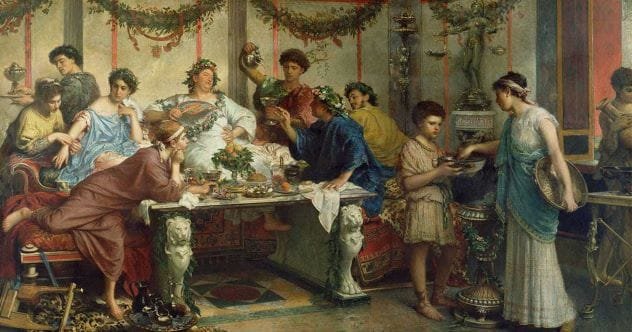
Roman banquet parties, called convivia, adapted from Greek symposia, were less philosophical and more political. Respectable women attended but couldn’t recline like men. Unlike Greek parties, convivia offered wine from start to finish.
The Roman Empire’s vast reach meant a wide array of foods at these banquets. Naked waiters served wild sow’s udders, African ostrich, and peacock tongue. Reclining men in togas gorged on delicacies and wine without moderation, often until they vomited, then continued eating.
Conspiratorial intrigue was common. At a banquet in 375 BC, a drunken Cleitus the Black called out Alexander the Great, who threw an apple, then a javelin, killing him. In 54 AD, Emperor Claudius died after a banquet, rumored to be poisoned by his wife Agrippina for her son Nero’s benefit. Nero later had her assassinated.
The wildest convivia paled compared to Bacchanalia festivals honoring Bacchus, the god of wine and ecstasy. These parties included drinking, dancing, sexual initiation, and even murder. Women outnumbered men three to one! Considered a cult, they were frowned upon by conservative Romans.
In 186 BC, the Senate investigated Bacchanalia, fearing insurrection. They dismantled chapters and set strict guidelines. 7,000 participants were arrested, mostly executed. You know a party is out of control when thousands end up in jail!
When Fermentation Meets Distillation

The origin of distillation is uncertain, but it predates written history. Initially used for perfumes and medicinals, early stills even purified seawater. Then, someone threw in wine and got brandy! Next, grain mash produced a significant upgrade in partying.
Traveling monks likely brought perfume distillation to Ireland around 1000 AD. Within a century, the Irish morphed the process into making spirits. Early whiskey was unaged and flavored with herbs, evolving into today’s Irish whiskey.
Public houses, or pubs, have existed in Ireland for about a thousand years, serving as meeting places for the working class to converse and drink. Some establishments are ancient. Sean’s Bar in Athlone, County Westmeath, has reportedly operated since 900 AD. Imagine the partying there over 1,100 years!
The British discovered gin in Holland during the Thirty Years’ War. King William III made gin more popular than beer for the working class due to mass production and lower costs. “Gin and gingerbread” festivals popped up along the River Thames in 1731. These “London Frost Fairs” featured tents selling hot gin. Public behavior spiraled, and gin-related deaths rose, prompting the government to impose a distiller’s license at 50 pounds. It worked, as only two licenses were purchased seven years later.
In North and Eastern Europe, Russia, Poland, and Sweden developed vodka separately during the Middle Ages. Vodka consists of ethanol and water and can be made from cereal grains, potatoes, rice, grapes, or sugar water. Russians embrace it as their national drink, serving it at every celebration. Their favorite toast? “May we always have a reason for a party!” They have stringent rules: serve with bread, down the glass in one gulp, and discard the bottle cap.
Pre-Columbian Socials

A common misconception is that alcoholic beverages were nonexistent in the Americas before Europeans. While distillation was mostly unknown, pre-1492 imbibing occurred among Indigenous people. Ancient Mesoamericans fermented anything they could find, generally using beverages communally in spiritual ceremonies.
For thousands of years, the Mayans made alcoholic drinks from honey, corn, pineapples, cacti, tree bark, and sap. One favorite, balché, was ingested both orally and as an enema. Conquistadors stopped such ribald revelry. The Olmec people (1100-900 BC) produced cacao wine for ceremonies, the earliest consumption of the tree from which we make chocolate. Chocolate and wine still make for a great party start.
To the north, Native Americans indulged in fermented beverages, more common in agricultural regions. Yuman tribes south of the Grand Canyon hosted parties with neighboring villages, serving saguaro fruit wine, encouraging dancing, celebrating alliances, and planning attacks. Pueblo Indians along the Rio Grande celebrated the end of winter with fermented grain. The Huron tribe of the Northeast made beer for feasts, leaving unripe corn in stagnant water for months.
Many tribes traditionally forbade alcohol consumption, proving they had sampled it and found it corrupting.
Pilgrims and Patriots Raising Their Glasses

The first Puritan ship, the Arabella, sailed to America in 1630 with 10,000 gallons of beer and wine compared to 3,500 gallons of water, following the example of the Pilgrims.
The Pilgrims, who arrived at Cape Cod in 1620, consumed about a gallon of beer daily. By the time they reached America, they had to get creative, making beer from corn, spruce, and pumpkins, plus hard cider from apples. In 1621, they held a three-day autumn feast with the Wampanoag Indians, likely serving alcoholic beverages, including pumpkin beer and hard cider. History repeats itself as these drinks are making a comeback.
The Pilgrims and Puritans distrusted plain water, preferring fermented beverages, which killed harmful bacteria. They mainly drank beer—full of nutrients—at every meal. Alcohol wasn’t just for adults; children also had their ration of beer. If the church elder smelled beer on children’s breaths on the Sabbath, all was well.
Moving forward to the Boston Tea Party on December 16, 1773, men threw back pints and sang rebellious songs at the Green Dragon Tavern. Fueled by alcohol and fury, they rampaged onto Griffin’s Wharf disguised as Mohawk Indians, raiding ships and vandalizing property. Have a few more, boys…
Forbidden Fruit

John Chapman, Johnny Appleseed, planted cider apple trees and dogfennel, a poisonous weed. Temperance advocates felt the same about his apple trees.
Alcohol consumption in the U.S. was at an all-time high in the 1820s. Temperance movements attacked whiskey and cider, declaring cider more dangerous as its lower alcohol content allowed more time for mischief. Evangelicals suggested burning orchards, and one orchard owner cut down his trees so his apples couldn’t “promote intemperance.” Orchards became abandoned, but people still raised mugs of cider in bars, secure in their right to do so!
It took over a hundred years of activism before they lost that right.
Prohibition Was a Blast!

The Eighteenth Amendment went into effect in 1920, and underground drinking clubs, speakeasies, popped up everywhere. Patrons whispered a secret password to enter and spoke quietly inside.
These clubs used music and dancing to lure people in. Women started going to bars for the first time. Color lines were crossed as blacks and whites partied together to jazz music. Bootleg bathtub gin tasted horrible, so bartenders mixed it with juice or soda—the cocktail was born.
New York had 30,000 to 100,000 speakeasies. Chumley’s, a historic pub in Greenwich Village, opened in 1922. It was rumored to be part of the Underground Railroad. Ernest Hemingway and F. Scott Fitzgerald were patrons. The term “86’d” originated there, referring to the back entrance used to flee police raids. Chumley’s closed in 2020 due to the pandemic.
In San Francisco, speakeasies served fine spirits smuggled from Canada. City officials turned a blind eye to illegal drinking, and patrons weren’t afraid of raids. Clubs had front areas masquerading as shops with secret backrooms and underground tunnels. In 1933, Prohibition was repealed, and most speakeasies closed, but some remain with historic furnishings and secret passwords. Prohibition in San Francisco was a blast!
Boozing It Up Over the Holidays, and There Are Lots of Holidays

Many Americans start each new year at a party, already half-sloshed by the time the ball drops. There’s always room for champagne. They’ve got a month to recover before Super Bowl Sunday! Football fans spend over a billion dollars on beer each year planning the perfect indoor tailgate party, often starting the night before.
In March, Americans raise their glasses to the Irish, surpassing the actual Irish, as St. Patrick’s Day in Ireland is more moderate. In May, we celebrate Mexican heritage with tequila and cerveza during Cinco de Mayo festivals. In Mexico, the observance is regional.
We fly the flag during the summer months, soaking up the sun and suds. On Memorial Day, we drink beer at barbecues, and on the Fourth of July, colorful cocktails go well with fireworks. By Labor Day in September, we’re grateful for another day off and drink whatever we can.
Anyone who appreciates hard cider, pumpkin ale, or cranberry cocktails knows Halloween parties aren’t just for kids. These drinks carry over for formal gatherings, though it might not just be the turkey making you sleepy.
Christmas parties start while there’s still leftover stuffing. Regardless of the celebration, libations are served. In December 2020, Americans bought $16.3 billion worth of booze, dropping to $11.3 billion the following month—$5 billion worth of holiday cheer. Soon, another New Year’s Eve comes around. We raise our glasses, waiting for the ball to drop…life is good when you’ve got a buzz with friends.
What’s your favorite party memory? Share in the comments below!