
Remember when lasers seemed like stuff from sci-fi movies? Well, those days are long gone! First dreamed up in the 1950s, lasers were once called ‘a solution looking for a problem.’ Fast forward to today, and these powerful beams of light are everywhere. From healing our bodies to exploring the cosmos, laser technology is a superstar in innovation. Get ready to be amazed as we dive into 10 cutting-edge ways lasers are shaping our world, proving they’re more exciting than ever!
10 Chirped Pulse Amplification
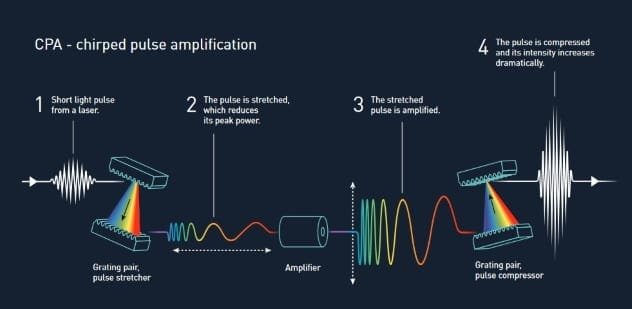
Chirped Pulse Amplification, or CPA, is a truly amazing piece of modern tech. This smart technique creates super-strong laser pulses. The cool part? It doesn’t wreck the material the light passes through. Think of it like this: light bursts are stretched out to lower their power. Then, they get a big boost and are squeezed back together. This makes a light pulse with incredible strength.
CPA started in the mid-1980s. Now, it’s very common in eye surgery. Doctors use these strong lasers to fix vision by reshaping the eye’s cornea. But that’s not all! CPA might also help build super-fast computers and better ways to store information. Scientists think CPA could make computers 100,000 times faster than the ones we use today.
Even though we’re still learning all CPA can do, it’s already made a big splash in science. Two scientists who created it, Donna Strickland and Gerard Mourou, even won the Nobel Prize in Physics in 2018 for their work. It was a big moment, especially since Strickland was the first woman physicist to win the Nobel since 1963!
9 Clearing Train Lines

Wet leaves on train tracks might sound like a small problem, but they can cause big trouble for trains. When trains run over leaves again and again, the leaves get squished into a slippery mess. This slick coating makes the tracks dangerous because it reduces grip for the train wheels.
Usually, train companies try to clean tracks with water jets or by spreading sand for more grip. But these methods can damage the tracks. Plus, carrying water and sand around is a hassle. Now, there’s a high-tech fix: lasers! A company called LaserThor came up with the idea to blast leaves off with powerful lasers. Their Nd:YAG laser heats up leaves and other gunk to an incredible 5,000 degrees Celsius (9,032 °F), turning them into vapor.
Back in 2014, a Dutch train company decided to test this laser system on one of their trains. Besides zapping away leaves, the laser’s heat also dries the rails. This helps stop them from rusting. Talk about a bright idea for safer train travel!
8 Laser Cooling
Using lasers to cool things down sounds a bit strange, right? After all, lasers usually make things hot! But in the mid-1980s, a smart physicist named Steven Chu showed how laser beams can actually cool atoms to super-low temperatures. It’s all about slowing things down.
Imagine tiny particles in a gas whizzing around full of energy. When you cool the gas, these particles lose energy and slow down. So, if you can slow down atoms, you can make the gas colder. That’s the big idea behind laser cooling. When an atom moves towards a laser, it soaks up light particles (photons) from the beam. This makes the atom slow down. As it slows, it loses energy and its temperature drops.
Scientists figured out that it takes about 20,000 photons to stop a sodium atom completely. That sounds like a lot, but lasers can make atoms absorb about ten million photons every second! This means atoms can be cooled down to almost a dead stop in just milliseconds. Over the last 30 years, this tech has gotten so good that physicists can now cool atoms to just a billionth of a degree above absolute zero—that’s unbelievably cold!
7 Manipulating Rodents

Scientists are always finding new ways to study behavior, and lasers are helping them in fascinating ways, especially with rodents like rats and mice. For example, laser technology has helped researchers reverse alcoholism in rats. A team at Scripps Research in California managed to reduce how much alcohol-dependent rats wanted to drink. They did this by putting tiny fiber optics into the rats’ brains and shining a laser on specific brain cells. One professor described it as being as quick and easy as “flipping a switch.”
This work is pretty amazing, but it’s not the first time lasers have been used to change how small animals act. A couple of years earlier, scientists at Yale University used a similar method to trigger hunting instincts in mice. By shining blue laser light on certain neurons in the mice’s brains, they could make the mice bite, grab, and show other ‘killer’ behaviors. These studies help us understand the brain better.
6 Holographic Data Storage
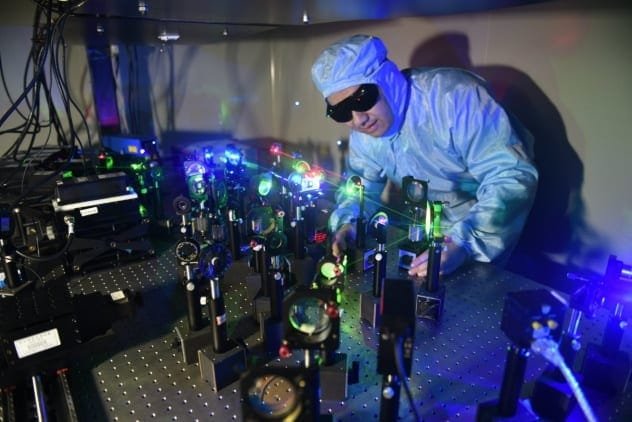
Ever since CDs came out in the 1980s, lasers have been key for recording, storing, and playing our data. But this tech has its limits. CDs and DVDs store information only on their surface. This means there’s a cap on how much data they can hold, based on how big the disc is.
Scientists are now looking at a cool new way to store much more information: holographic data storage. Instead of just using the surface, these devices would store data as 3D holograms inside a material. This could mean holding tons more information in the same amount of space. Plus, it’s expected to be a faster and more reliable way to store data.
So, why aren’t we all using holographic albums or movies yet? Well, this technology is still in the testing phase. Companies have tried to make commercial holographic storage, but nothing has really taken off. One promising idea comes from a university in China. Researchers there made a special film with tiny silver particles. A laser system changes these silver particles to write data, and different colors of light affect the particles in different ways.
5 Contact Lenses
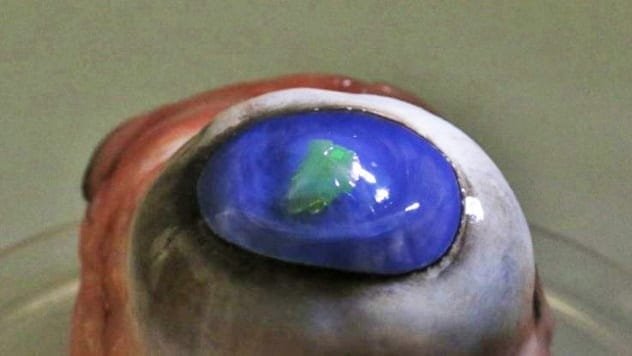
It’s not quite Superman’s laser vision, but scientists have created something almost as cool: a contact lens that can shine a laser beam right out of your eye! This amazing feat is possible thanks to a super-thin film. How thin? Only a thousandth of a millimeter thick! This tiny film can be stuck onto or even built into a regular contact lens.
This futuristic tech was shown off in 2018 by physicists from the University of St Andrews. They believe these laser-equipped lenses could be used for things like wearable security tags. Imagine scanning your eye to get into a secure building! When they tested the lens on a cow’s eyeball, it produced a laser beam with a tiny bit of power, about a nanowatt. It’s a small start, but a big step for tiny tech!
4 Military Drone Defense

Laser weapons might sound like they belong in a sci-fi movie like Star Trek, but they are quickly becoming a real part of military technology. Recently, the US Marine Corps started testing their Compact Laser Weapons System, or CLaWS. This system is mounted on a vehicle and is designed to shoot down enemy drones, also known as UAVs. Compared to regular guns, laser weapons can be cheaper to use. They also make it harder for drones to spot and target soldiers on the ground.
Other countries are also using laser tech. As things get tense in the Middle East, Turkish forces have been showing off their own laser weapons. In fact, Turkey became the first country to use a ground-based laser system to take down an enemy vehicle in actual combat. In August 2019, they used their laser weapons to destroy an armed drone from the UAE that was flying over a district in Libya.
3 Detecting Gravitational Waves

Imagine ripples in space, like waves in a pond, but much, much bigger. These are gravitational waves. Scientists first thought they might exist way back in 1916, but finding them was super tricky. It took almost 100 years of new technology before we could finally spot them. And guess what made it possible? Lasers!
In 2015, researchers at LIGO (Laser Interferometer Gravitational-Wave Observatory) announced they had detected gravitational waves for the first time. This was huge news for physicists and astronomers everywhere. Gravitational waves are like cosmic echoes that travel across the universe at the speed of light. As they pass through space, they stretch and squeeze everything around them, just a tiny bit. These changes are so small that you need incredibly sensitive laser detectors to measure them. LIGO uses lasers and mirrors to spot these tiny wobbles caused by passing gravitational waves. It’s an amazing way to listen to the universe!
2 Bioprinting Stem Cells

Bioprinting sounds like something from the future, but it’s a real and growing field in medicine. Experts use it to create artificial organs and tissues. Think of it like 3D printing, but instead of plastic, it uses “bioink”—a special goo containing living cells. Layer by layer, droplets of this bioink are placed to build working 3D structures.
In 2018, researchers in Germany at Laser Zentrum Hannover found a way to bioprint a special kind of stem cell called hiPSCs. These human-induced pluripotent stem cells are amazing because they can turn into any other type of cell in your body. This makes them perfect for building replacement organs or creating systems for testing new drugs on personalized tissues.
So, how do lasers fit in? The hiPSCs are mixed into the bioink and spread on a glass slide. Another glass slide is placed just below it. Then, short pulses of laser light are used to gently push tiny droplets of the bioink (with the cells) from the top slide onto the bottom one. Early tests have been very successful. Almost all the cells survived the laser printing process and kept their amazing abilities.
1 Optical Tweezers
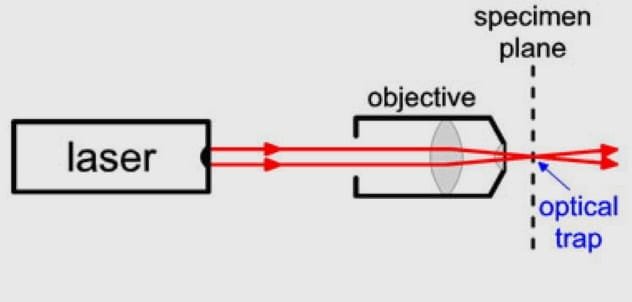
Remember Donna Strickland and Gerard Mourou, who won a Nobel Prize for CPA? Well, in the same year, 2018, another brilliant mind in optics, Arthur Ashkin, also received the Nobel Prize. His invention? Optical tweezers! These aren’t your everyday tweezers for plucking eyebrows; these are tools made of light.
Optical tweezers are incredible instruments that have tons of uses in biology. Scientists use them to study how live bacteria move around or to look closely at the properties of DNA. Ashkin’s technique uses a very focused beam of infrared laser light to grab and hold tiny microscopic objects, like cells or particles, right in midair. It’s like a tiny tractor beam!
How does it work? The object gets caught in the center of an “optical trap.” As the object interacts with the photons (light particles) from the laser, forces from the light push and pull it, keeping it locked in place. This allows scientists to move and study tiny things without actually touching them. It’s a revolution for exploring the microscopic world!
From the tiniest particles to the vastness of space, laser technology has truly found its purpose. What started as a scientific curiosity is now a powerful tool driving incredible advancements across many fields. These ten examples are just a glimpse of how lasers continue to light up the path to a brighter, more innovative future. It’s clear that the story of laser technology is far from over, with more exciting developments surely on the horizon.
What use of laser technology do you find most fascinating? Share your thoughts in the comments below!