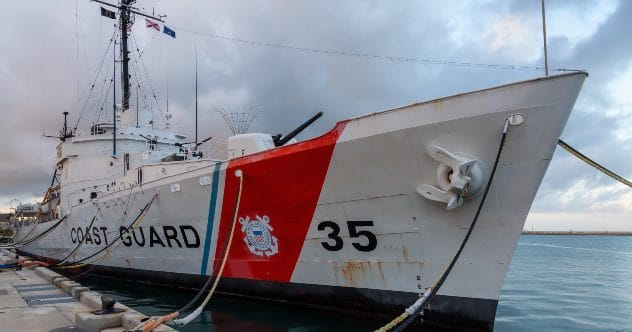
Founded way back in 1790, the United States Coast Guard is the only military service that’s part of the Department of Homeland Security. Its main job? Keeping the U.S. safe by enforcing maritime laws. This means protecting our ports, waterways, and people from threats both near and far.
Even though it’s one of our oldest military groups, many folks are still in the dark about its rich history and important duties. Ready to learn more? Let’s dive into ten fascinating things you probably didn’t know about the U.S. Coast Guard.
10. The U.S. Coast Guard Is Indeed a Military Branch

It’s a common mistake to think the U.S. Coast Guard (USCG) isn’t part of the military. That couldn’t be more wrong! While it’s not under the Department of Defense (DoD), the USCG is definitely an arm of the United States Armed Forces. It used to be with the Department of Transportation but was moved to the Department of Homeland Security more recently.
Why is it considered military? During wartime or major conflicts, the President can transfer Coast Guard resources to the Navy. Plus, their ranking system is very similar to the Navy’s, with the top officer being a four-star admiral, the Coast Guard Commandant. Over the years, the USCG has taken on many roles, including maritime law enforcement, search and rescue, protecting the environment, aiding navigation, ensuring military readiness, and port security.
9. The Coast Guard’s Mission Differs from the U.S. Navy

Sometimes people mix up the Coast Guard and the Navy because their work seems similar at first glance. However, they have very different jobs and missions. The Coast Guard focuses on maritime law enforcement. The Navy’s mission, on the other hand, is to train and equip a force that fights to protect the freedom of U.S. waters and economic interests; it’s part of the Department of Defense.
Their duty stations are also quite different. The Navy has bases all over the world. Coast Guard duty stations include air stations and other bases mainly along the U.S. coastline to allow for quick responses to emergencies and rescue missions. Organizationally, the Coast Guard has eleven main areas like drug interdiction and marine safety, while the Navy is split into eight communities like SEALS and Cyber Warfare.
8. The U.S. Coast Guard Deploys Its Members Globally

Coast Guard members can be deployed for various missions, lasting anywhere from a few weeks to several months. Their deployment history is long and storied, dating back to 1790. They’ve played roles in major U.S. conflicts like World War II, the Vietnam War, and Operation Iraqi Freedom, participating in 17 wars and conflict missions in total. It’s also worth noting that the Coast Guard is the oldest continuous seagoing service in the U.S., established even before the U.S. Navy.
7. Top-Notch Swimming Skills Are a Must

It might seem obvious that you need to be a good swimmer for the Coast Guard, but it’s shocking how many people fail the swim test – about half! Many underestimate just how skilled Coast Guard rescue swimmers need to be.
The test involves diving from a 5-foot platform and swimming 100 meters (about 328 feet) in around five minutes, all without goggles and without touching the pool’s sides or bottom. Recruits also need to tread water for five minutes without a life jacket. Failing these means extra swim lessons, as passing is mandatory for graduating from basic training. A fear of water? That’s an automatic no-go for recruitment.
6. The Coast Guard Flies Two Distinct Flags

The Coast Guard actually has two official flags: the Coast Guard Ensign and the Coast Guard Standard. The Ensign features 16 vertical red and white stripes (representing the 16 states at the time of its design) with the Union Jack in the corner on a white field. Its original purpose was to help distinguish Revenue Cutter vessels from merchant ships.
The Coast Guard Standard, first depicted in 1917, was initially white with a blue eagle and a semi-circle of 13 stars. It was later redesigned to include the words “United States Coast Guard—Semper Paratus” and a full circle of 13 stars. Today, the Coast Guard Standard is adorned with 34 battle streamers during ceremonies. The current version of the Standard was officially adopted in 1964.
5. Joining the U.S. Coast Guard Is Highly Competitive

Getting into the U.S. Coast Guard is tougher than many realize. They recruit fewer people than other military branches and have very strict entry requirements. Besides basic physical fitness and citizenship, academic qualifications need to be strong. A college degree or high school diploma is usually needed, along with a minimum score of 54 on the Armed Services Vocational Aptitude Battery (ASVAB) test. GEDs are rarely accepted.
Applicants also undergo thorough security and credit checks. The Coast Guard has the fewest waivers for medical issues and criminal history in the military. Interestingly, it’s the only branch where a shellfish allergy is an automatic disqualifier, no exceptions! Professionalism, respect, honesty, physical capability, and a strong work ethic are all key.
4. A Rich Journalistic Legacy Thanks to Alex Haley

Alex P. Haley, famous for writing Roots, was the U.S. Coast Guard’s first-ever chief journalist. He joined at 18 as a mess attendant. During World War II, serving on ships, he honed his writing skills by penning at least forty letters a week. His talent didn’t go unnoticed; shipmates began paying him to write letters for them.
After the war, Haley pursued writing more seriously and requested a transfer to a journalist rating. Even though such a rating didn’t exist then, the Coast Guard recognized his abilities and created the position for him. He served as an assistant to the Public Relations Officer until his retirement in 1959. Later, his novel Roots won a Pulitzer Prize, and his Autobiography of Malcolm X also gained widespread acclaim. Haley also became a senior editor at Reader’s Digest.
3. A History Spanning Over Two Centuries

The Coast Guard was the nation’s only armed force on the seas until the Navy Department was established in 1798. Its story began in 1790 when President George Washington authorized building vessels to stop smuggling and enforce trade laws. These ships were initially called “revenue cutters.”
In 1915, the Revenue Cutter Service merged with the U.S. Life-Saving Service (which operated coastal rescue stations) and was officially named the Coast Guard. In 1939, it took over maintaining the nation’s maritime navigation systems (like lighthouses). Later, licensing marine vessels and enforcing maritime laws became part of its duties. Protecting our ports and coastlines remains one of its most vital functions.
2. The Coast Guard Is Surprisingly Compact

Believe it or not, the U.S. Coast Guard is the second smallest military branch, just after the Space Force. It has about 42,000 full-time members, around 8,000 reservists, 8,000 civilian employees, and an impressive 31,000 auxiliary volunteers. To put that in perspective, the Marine Corps has about 200,000 active members, and the Army has around 550,000.
Despite its smaller size, the U.S. Coast Guard is considered the world’s largest and most powerful coast guard, often rivaling the naval forces of other entire countries in terms of capability and reach.
1. More Than Just Maritime Law Enforcement

While enforcing maritime laws is a core duty, it’s just one piece of the Coast Guard’s puzzle. Their responsibilities are vast and varied. Search and rescue is one of their oldest and most well-known missions, aiming to save lives and property at sea. They also play a crucial role in drug interdiction, working with other agencies to stop illegal drug organizations from reaching U.S. shores, covering a transit zone of about six million square miles.
Lesser-known duties include enforcing international conventions on migrant repatriation, dealing with human smuggling, protecting marine ecosystems, preventing illegal ocean dumping, and responding to oil spills. They also enforce fishing agreements to protect the U.S. Exclusive Economic Zone (EEZ). Furthermore, the Coast Guard supports the Department of Defense with tasks like environmental protection, pest control, and even providing airspace security in Washington, D.C.
The U.S. Coast Guard, with its rich history and diverse missions, is truly a unique and vital part of America’s armed forces. From daring rescues at sea to protecting our delicate marine environments, their impact is far-reaching. It’s clear that these dedicated individuals do much more than many realize, often working behind the scenes to keep our waters and nation safe.
What fact about the U.S. Coast Guard surprised you the most? Leave your comment below!